Caffeine is the most widely consumed psychoactive substance on earth. An estimated 80% of the global adult population ingests it daily — in coffee, tea, energy drinks, pre-workout supplements, soft drinks, and an expanding array of functional food products. It is also, as the sport science literature has established across decades of controlled trials, one of the most consistently effective ergogenic aids in competitive sport. These two facts together create an unusual problem: because caffeine is so normalized, most athletes have no idea how it actually works, what the real dose-response looks like, why it affects some people dramatically and others barely at all, or what the strategic implications are for competitive tennis specifically. The marketing ecosystem around caffeine — energy drinks promising euphoric peak performance, pre-workout labels listing 300 mg beside unpronounceable “proprietary blends” — has thoroughly obscured a compound with genuinely interesting and well-characterized pharmacology.
The Mechanism — Adenosine Receptor Antagonism
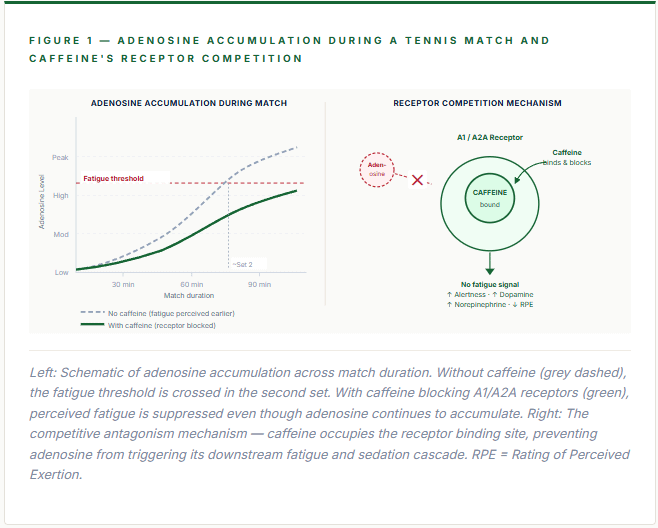
To understand what caffeine does, it is necessary to understand what adenosine does. Adenosine is a purine nucleoside — the same molecular backbone as ATP — that accumulates in the brain and peripheral tissues as a byproduct of cellular energy expenditure. As adenosine concentrations rise over the course of waking hours and physical activity, adenosine binds to specific receptors — principally the A1 and A2A subtypes — and produces a cascade of effects that the nervous system interprets as fatigue and the drive to sleep. Adenosine is not simply a sleep molecule; it is a molecular gauge of how much work the system has done and how depleted its energetic resources are.
Caffeine (1,3,7-trimethylxanthine) is structurally similar enough to adenosine that it competes for the same binding sites on A1 and A2A receptors. It binds to these receptors with meaningful affinity but does not activate them — it is a competitive antagonist. By occupying the receptors without triggering their downstream signaling, caffeine blocks adenosine’s access, preventing the fatigue and sedation signal from being read. Neuronal firing rates increase. Dopamine and norepinephrine release is enhanced. The perceived effort of a given workload decreases. Alertness, reaction time, and voluntary force production improve — not because caffeine adds energy, but because it suppresses the signal that your brain uses to register that energy has been spent.
This is the fundamental reason caffeine is controversial in the context of sport performance. It does not improve the underlying physiology — the muscles are not stronger, the heart is not more efficient, the VO₂max is not higher. What changes is the brain’s read of how fatigued the athlete is. In a competitive context where the margin between winning and losing is determined partly by who can push harder for longer despite accumulated fatigue, that is an extremely meaningful change. But it is a different kind of intervention than, say, creatine expanding the phosphocreatine pool, or beta-alanine raising muscle carnosine. Caffeine changes the signal. The other compounds change the substrate.
Caffeine does not give you more energy. It blocks the receptor that tells your brain you are running low on it. In a sport decided by who tolerates fatigue better in the third set, that distinction matters more than you might think.
The Evidence — What Caffeine Actually Does to Performance
The sport science literature on caffeine is among the largest bodies of evidence for any nutritional intervention, with hundreds of controlled trials published across the last four decades. The summary picture is one of consistent but context-dependent effects, with the magnitude of benefit varying by the outcome measured, the dose used, the individual tested, and the sport modality.
Endurance and Time-to-Exhaustion
The earliest and most robust evidence base is in aerobic endurance. A 2010 meta-analysis by Ganio and colleagues (33 studies) found that caffeine improved endurance performance by a mean of 3.2%, with effects detectable across cycling, running, rowing, and multi-sport protocols. The mechanism here is primarily the reduction in Rating of Perceived Exertion (RPE) — the same workload feels easier, allowing athletes to sustain higher output before hitting their subjective limit. A secondary contribution from enhanced fat oxidation was proposed in earlier literature (caffeine-induced adrenaline release stimulates lipolysis), though the magnitude of this effect at typical doses is now considered modest and context-dependent.
Strength and Power
Effects on maximal strength and explosive power are smaller and less consistent. A 2018 meta-analysis by Grgic and colleagues found significant improvements in both upper- and lower-body maximal strength with caffeine, with effect sizes in the small-to-moderate range (0.19–0.20 standard deviations). Effects on ballistic tasks — jump height, sprint power — are similarly moderate. The relevant mechanisms include caffeine’s enhancement of calcium release from the sarcoplasmic reticulum (improving muscle contractility independently of the adenosine pathway) and its central nervous system effects on motor unit recruitment and voluntary activation.
Reaction Time and Cognitive Performance
For tennis specifically, the cognitive effects may be as important as the physical ones. Caffeine consistently reduces simple and choice reaction time in the range of 20–30 milliseconds — a modest absolute number that nonetheless has meaningful implications for a sport where the return of a 200 km/h serve gives approximately 400 milliseconds of total processing time. A 2016 meta-analysis by McLellan and colleagues found reliable improvements in attention, vigilance, working memory, and executive function at doses of 40–300 mg. These effects are particularly pronounced when baseline alertness is reduced — in early-morning matches, late-night tournament draws, or extended play.
A 2019 study by Goncalves and colleagues specifically tested caffeine in tennis players (3 mg/kg), finding significant improvements in stroke consistency, footwork speed, and serve velocity across a simulated match protocol. This is the kind of ecologically valid evidence the field needs more of, and it aligns mechanistically with what the general caffeine literature would predict.
Dosing — What the Evidence Actually Supports
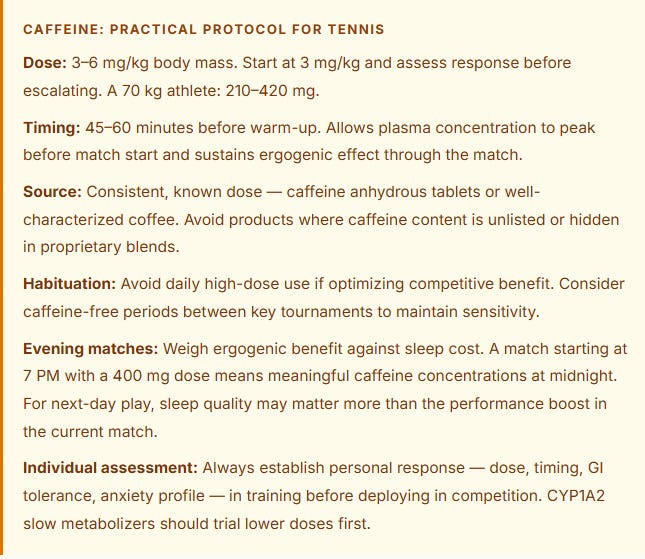
The dose-response relationship for caffeine is real but has a ceiling. The majority of the performance literature shows meaningful ergogenic effects at 3–6 mg per kilogram of body mass. For a 70 kg athlete, that is 210–420 mg — roughly equivalent to two to four standard espresso shots, or one to two cups of filtered coffee depending on brew strength.
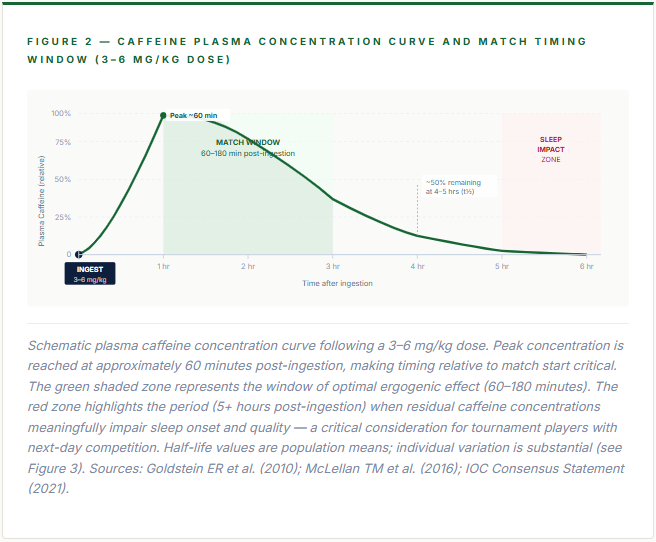
Effects at doses below 2 mg/kg are inconsistent. Effects above 6 mg/kg produce diminishing additional performance benefit while substantially increasing adverse effects — anxiety, tremor, tachycardia, gastrointestinal distress, and impaired sleep recovery. The 2021 IOC Consensus Statement on dietary supplements and the high-performance athlete lists caffeine as a Tier 1 ergogenic aid (strong evidence, likely safe when used appropriately) at doses of 3–6 mg/kg consumed approximately 60 minutes before competition.
Peak plasma caffeine concentration is reached approximately 30–60 minutes after ingestion, with significant individual variation. The plasma half-life averages 4–6 hours in adults — meaning that a 400 mg dose consumed an hour before a match is still present at meaningful concentrations three to four hours later, complicating recovery, post-match nutrition, and sleep. For evening matches or tournament scenarios with next-day play, this pharmacokinetic reality requires planning..
The Genetics Problem — CYP1A2 and Individual Variation
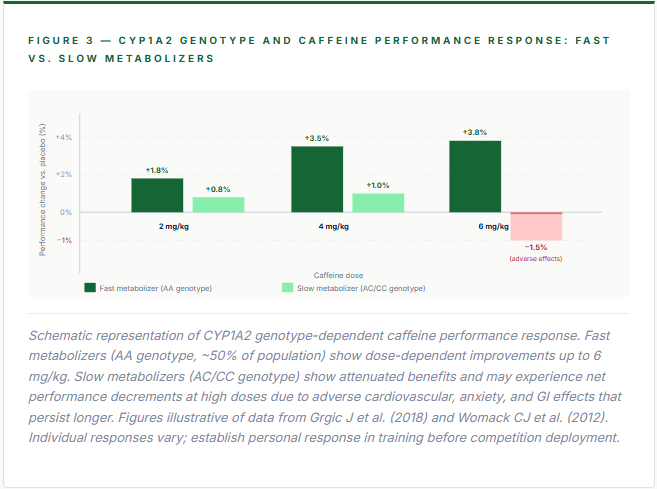
Caffeine is metabolized almost entirely in the liver by the cytochrome P450 enzyme CYP1A2. The gene encoding this enzyme — CYP1A2 — is highly polymorphic, and specific variants produce dramatically different metabolic rates. The most studied variant is the -163C>A single nucleotide polymorphism (rs762551), which divides the population into two phenotypes: fast metabolizers (AA genotype) and slow metabolizers (AC or CC genotype).
Fast metabolizers clear caffeine from the bloodstream approximately twice as quickly as slow metabolizers. The performance implications of this are substantial and have been systematically underappreciated by both the supplement industry and many coaches. A 2018 study by Grgic and colleagues noted that the CYP1A2 genotype may explain a significant portion of the variance in caffeine’s ergogenic effect — with fast metabolizers showing consistent, dose-dependent performance improvements, while slow metabolizers show attenuated benefits and in some protocols actually demonstrate performance decrements at higher doses, possibly because the slower clearance rate allows caffeine to interfere with its own ergogenic mechanism through receptor downregulation or creates adverse cardiovascular and GI side effects that impair rather than enhance output.
The practical implication is blunt: if you have tried caffeine supplementation and experienced minimal benefit, jitteriness, pronounced GI distress, or heart palpitations that persisted well into the afternoon from a morning dose, slow metabolism is the most likely explanation. Genetic testing for CYP1A2 status is available commercially. It is not required — simply trialing lower doses, or accepting that caffeine is not a useful ergogenic aid for a given individual, is equally valid.
The Creatine Controversy — Antagonism or Addition?
No discussion of caffeine in sport science is complete without addressing the creatine-caffeine interaction — a story that illustrates how a single imperfect study can shape practitioner belief for decades.
In 1996, Vandenberghe and colleagues published a study in the Journal of Applied Physiology suggesting that caffeine co-ingestion abolished the ergogenic benefit of creatine loading during a cycling sprint protocol. The paper was widely cited and gave rise to a persistent recommendation to avoid combining the two compounds. The problem is that this study had several significant limitations: it used extremely high caffeine doses (approximately 6 mg/kg daily, far above the doses used in typical supplementation), it measured a specific cycling sprint protocol that may not generalize to other tasks, and it was not replicated by subsequent work.
A 2011 study by Trexler and colleagues and subsequent meta-analytic work found no evidence that caffeine at moderate doses (3–6 mg/kg acutely) interferes with creatine’s effects on muscle phosphocreatine content or on strength and power performance in protocols where creatine shows benefit. The two compounds act through entirely different mechanisms — creatine expands the PCr pool, caffeine modulates receptor signaling — and there is no biologically compelling reason they would antagonize each other at typical doses. The weight of current evidence supports additive rather than antagonistic effects, though the combination has not been as thoroughly studied as either compound alone.
The Verdict on Creatine + Caffeine
The 1996 Vandenberghe study should not guide current practice. It used atypically high caffeine doses, in a specific protocol, without replication. The current evidence supports that moderate acute caffeine supplementation (3–6 mg/kg) does not interfere with the performance benefits of chronic creatine loading. Athletes who use both compounds based on their individual assessment of each need not concern themselves with this interaction at standard doses.
Habituation — What Happens With Daily Use
Caffeine’s ergogenic effects are attenuated by chronic high-dose exposure. The mechanism is receptor upregulation: repeated adenosine receptor blockade leads the nervous system to increase receptor density and sensitivity, partially compensating for the antagonism. This is why habitual high-dose caffeine consumers report needing progressively more coffee to achieve the same alert state, and why withdrawal — typically characterized by headaches, fatigue, and irritability peaking 24–48 hours after cessation — is a real phenomenon with documented neurological correlates.
The implications for sport performance are nuanced. A 2002 study by Bell and McLellan found that habitual caffeine consumers showed smaller ergogenic effects than non-consumers at the same dose, but effects were not eliminated. A 2010 study by Irwin and colleagues found that a period of caffeine abstinence (7 days) partially restored the ergogenic effect in habitual consumers. The practical inference — that habitual consumers should abstain before important competition to maximize the ergogenic effect — has some support but requires balancing against the risk of withdrawal symptoms during the abstinence period and the competitive environment itself.
The most evidence-consistent approach for the high-performing competitive athlete is to avoid daily high-dose caffeine use, treat caffeine as a performance intervention rather than a daily necessity, and use it strategically for key training sessions and important competitions. This is more easily stated than implemented in a culture where morning coffee is ritualistic — but the pharmacology is clear.
The Compounding Training Load Argument — A Counter-Position
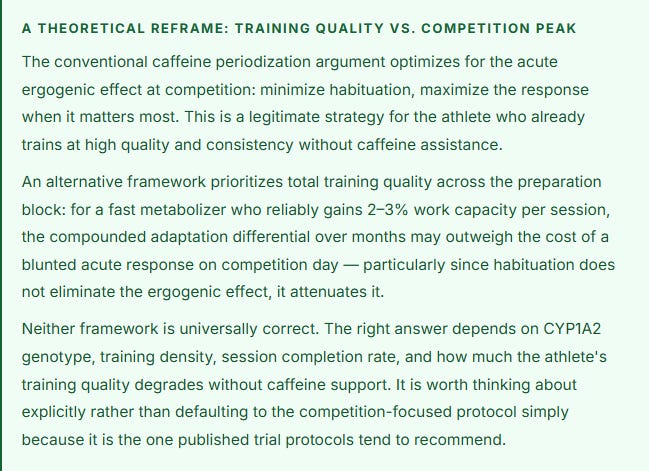
The “abstain to preserve the peak effect” framework deserves a significant qualification that the controlled trial literature is structurally unable to capture. Consider a fast metabolizer (AA genotype) who reliably produces 2–3% more total work per training session with caffeine than without.[15],[7] In any single session, 2–3% is modest — a few extra repetitions, slightly faster court coverage, a training segment completed rather than cut short. Over a week of six sessions, the difference is still small in absolute terms. Over six months of a competitive preparation block, it is not small at all.
Compounded training load does not work like compound interest in the simple mathematical sense, but the principle is directionally valid: consistent small increments in session quality accumulate into measurably different physical adaptations over training cycles of sufficient length.[17] An athlete who consistently trains at 102–103% of their unassisted capacity over a six-month block arrives at the competitive season having done genuinely more work than their unassisted counterpart — more total volume, more time above threshold, more progressive overload. The controlled trial, which measures acute performance in a single session against placebo, cannot observe this effect by design.
There is a second consideration that laboratory protocols systematically miss: caffeine’s role in what might be called the margin session. Coaches observe this constantly in practice. The athlete who arrives to a 6 AM court session on three hours of sleep and a full academic or work schedule. The extra conditioning segment at the end of a two-hour session. The recovery day that becomes a productive technical session rather than a lost day. In each case, caffeine is not enhancing a well-rested athlete’s already-high-performance baseline — it is determining whether a productive session happens at all, or whether it is truncated, abandoned, or replaced with passive rest.[16] These events are invisible to controlled trials but are among the most frequent real-world observations coaches report across competitive training environments.
Energy Drinks, Pre-Workouts, and the Marketing Problem
Energy drinks deliver caffeine — but how much, in what form, and alongside what else varies substantially across brands and can sizes. A standard 250 ml serving typically contains 80–150 mg of caffeine; larger formats (350–500 ml) commonly reach 150–300 mg. Some of that range falls below the ergogenically relevant threshold; some of it falls squarely within it. The fundamental problem is not necessarily the dose — it is control and predictability.
Most energy drink formulations combine caffeine with taurine, B-vitamins, sugar, and various amino acids or botanical extracts, in proportions that are either unlisted or listed without quantities. The interaction effects between these compounds and caffeine are not well characterized in the performance literature. Taurine, for instance, has its own adenosine-pathway implications; high acute sugar loads affect insulin and cortisol independently; certain botanical stimulants may produce additive central nervous system effects that are difficult to predict in advance. The result is that two athletes consuming the same product in the same session may report meaningfully different responses — not because caffeine is variable, but because the surrounding formulation is.
Pre-workout supplements compound this problem. Caffeine doses in these products range from 150 mg to 400 mg per serving, which places them at or above the ergogenically relevant range. But the accompanying ingredient lists are frequently extensive — beta-alanine, citrulline, arginine, creatine, HMB, various “focus” and “pump” compounds — often declared under a “proprietary blend” that does not specify individual doses. This makes it impossible to attribute any observed performance effect to any specific ingredient, or to reliably adjust dosing based on desired outcome. Some products have additionally tested positive for unlisted stimulants and substances — an established concern in third-party testing programmes.
The practical case for energy drinks and pre-workouts is not that they are ineffective — it is that they are not the most reliable delivery vehicle for a compound whose ergogenic effect depends on controlled dosing at a known time. If the goal is caffeine’s performance benefit, the cleaner path is a known source at a known dose: well-characterized coffee, or isolated caffeine anhydrous where precision matters most. These remove the interaction variables, put the dosing decision in the athlete’s hands, and make it possible to actually learn how caffeine affects you — rather than how a particular formulation on a particular day did.
Why Caffeine Is Controversial
The “very controversial” framing around caffeine in popular athletic culture usually conflates two distinct issues: the scientific controversy (essentially resolved — caffeine works for most people at appropriate doses through a well-characterized mechanism) and the ethical and practical controversies (still live).
On the ethical side: caffeine was on the World Anti-Doping Agency (WADA) prohibited list until 2004, when it was removed due to its ubiquity in everyday foods and beverages. WADA continues to monitor caffeine use and could re-add it to the Monitoring Programme at any time. Caffeine is legal in professional tennis at any dose. The ITF anti-doping programme follows the WADA code, and caffeine is not a prohibited substance. This is not expected to change imminently, but athletes competing at the ITF and ATP/WTA levels should verify current programme status, as regulatory positions can evolve.
The practical controversy is more persistent: caffeine is genuinely an ergogenic aid — an intervention that improves performance beyond the athlete’s natural baseline in a direct pharmacological manner. Some competitive athletes and coaches find this uncomfortable, particularly in a sport that emphasizes the primacy of technique, training, and mental fortitude. This discomfort is legitimate, but it does not change the pharmacology. Caffeine changes the game in the same direction as creatine and beta-alanine, just through a different pathway. Whether to use it is a decision for the individual athlete and their support team, made with accurate information.
Conclusion
Caffeine is a well-characterized, evidence-backed ergogenic aid with a mechanism that is now thoroughly understood and a performance effect that has been replicated across hundreds of controlled trials spanning every sport modality. Its effect is not on the underlying energy systems — the muscles are not stronger, the aerobic capacity is not higher — but on the brain’s read of how fatigued those systems are, through competitive antagonism of adenosine receptors whose accumulation normally signals the drive toward rest and reduced output.
For a tennis player, that mechanism is directly relevant. The fatigue that accumulates across a long match, particularly in heat, in a third set, or in the late games of a closely contested second — that fatigue is partly adenosine. A well-timed, appropriately dosed caffeine intervention does not eliminate that fatigue but delays when it becomes limiting, improves cognitive function when decision-making matters most, and sharpens reaction time on returns that allow 400 milliseconds of total processing.
The controversies are real but manageable. Individual variation due to CYP1A2 genetics is the most practically important: a meaningful fraction of the population metabolizes caffeine slowly enough that the adverse effects at high doses outweigh the benefits, and those individuals should use lower doses or abstain, whereas a meaningful fraction of the population metabolizes fast and stand to benefit from properly dosed caffeine during practice and competitive play. Where do you stand?
This completes the Nutrition & Ergogenic Aids track. The five compounds covered — ATP-based metabolism, protein, creatine, glycolytic buffering agents, and caffeine — represent the strongest evidence tier in applied sport nutrition for tennis. Everything else in the supplement market either has a weaker evidence base, works through mechanisms less specific to tennis physiology, or is covered more appropriately in the physiology and physical development tracks that follow.