Creatine is the most studied ergogenic aid in sport science history. That distinction is not hyperbole — it reflects decades of controlled trials spanning athletes, clinical populations, age groups, and more recently, neuroscience. And yet the supplement aisle version of creatine — the powder marketed with aggressive branding and implausible promises — has managed to obscure what is actually a well-characterized biological compound performing a well-understood function inside muscle and brain tissue. Creatine is not exotic. It is biosynthesized in the body from three amino acids and present in every piece of red meat you have ever eaten. The question is not whether creatine works. The question is why it works, how that mechanism operates specifically in the context of a tennis match, and what the evidence shows about a range of effects most athletes have never heard of.
What Creatine Is — and Where It Comes From
Creatine (methyl guanidinoacetic acid) is a naturally occurring nitrogenous compound synthesized endogenously from three amino acids: arginine, glycine, and methionine. The synthesis occurs primarily in the liver and kidneys, with the resulting creatine transported through the bloodstream and taken up into tissues — most importantly, skeletal muscle and the brain — via a specific creatine transporter (CrT1, encoded by the SLC6A8 gene).
Dietary creatine is present in animal-sourced foods. Red meat contains approximately 3–5 grams of creatine per kilogram of raw weight, and fish is comparable. Cooking denatures a portion of creatine to creatinine, so actual dietary intake from cooked food is somewhat lower. Plant foods contain negligible creatine, which is why vegetarians and vegans consistently show lower baseline muscle creatine concentrations — a point that will become relevant when we discuss supplementation response.
In the body, roughly 95% of total creatine is stored in skeletal muscle, existing in two forms: free creatine and phosphorylated creatine (phosphocreatine, or PCr). The ratio between free and phosphorylated creatine shifts dynamically based on the energy state of the muscle — at rest, approximately 60–70% of muscle creatine exists as PCr. The total muscle creatine pool in an unsupplemented individual typically sits around 120 mmol per kilogram of dry muscle mass. The physiological ceiling — the maximum the muscle can hold — is approximately 160 mmol/kg dry weight. Most people, on a typical omnivorous diet and without supplementation, operate at roughly 60–80% of their available capacity.
The Phosphocreatine System — ATP, PCr, and the Creatine Kinase Reaction
To understand creatine’s role in exercise, it is necessary to revisit the energy currency concept introduced in Part 1 of this series. All cellular work runs on ATP. Skeletal muscle stores enough free ATP to power approximately 1–2 seconds of maximal effort. This is not a limitation unique to untrained individuals — it is a structural feature of muscle physiology. The question is not how much ATP is stored but how quickly it can be replenished.
Phosphocreatine is the most immediate reserve for ATP replenishment. The reaction is governed by the enzyme creatine kinase:

The reaction is reversible. During maximal muscular effort, it runs to the right: PCr donates its phosphate group to ADP, rapidly regenerating ATP without requiring oxygen. At rest, the reaction runs to the left: aerobically produced ATP recharges free creatine back into PCr, restoring the buffer for the next bout of high-intensity work.
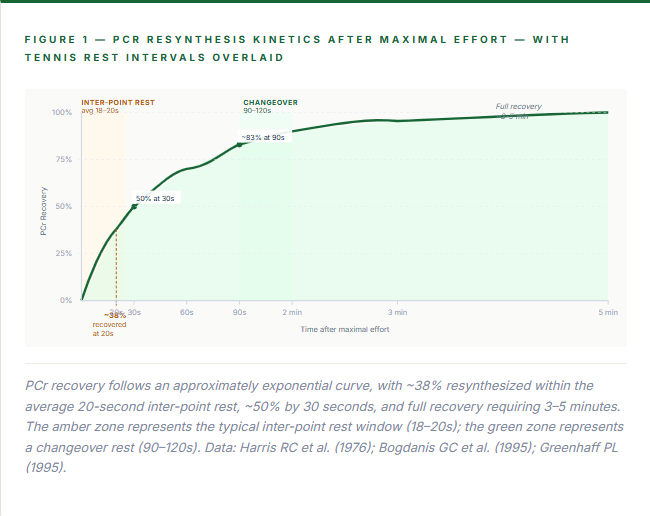
The practical ceiling of PCr-based ATP provision is approximately 8–10 seconds of all-out effort. This is not because the reaction slows — it is because the substrate (PCr) runs out. By the time a maximal sprint or explosive rally exchange has lasted 10 seconds, PCr stores are largely exhausted, and the energy burden shifts to glycolysis and eventually oxidative phosphorylation. After the effort ends, PCr resynthesis begins immediately — aerobically, requiring oxygen delivery to the working muscle — and follows a roughly exponential recovery curve.
.
The Tennis Case — Why PCr Kinetics Matter on Court
Tennis is a high-intensity intermittent sport. Points in competitive play typically last 5–15 seconds, with exceptional rallies extending to 30–40 seconds. The inter-point rest allowed under ITF rules is 20 seconds between points and up to 120 seconds during changeovers. In practice, actual rest between points averages 18–20 seconds — which, as Figure 1 shows, corresponds to roughly 38–45% phosphocreatine recovery from a fully depleted state.
This means that most players enter the next point with a partially depleted PCr system, not a fully restored one. Over the course of a single service game, let alone a full set, the accumulated deficit accumulates. The glycolytic system compensates, but glycolysis is slower to initiate ATP production, produces hydrogen ions that contribute to fatigue, and draws on a finite glycogen supply. The practical manifestation is what experienced players recognize as the fatigue that accumulates not during any single point, but across the arc of a long match — the legs that feel heavier in the third set, the first-step that no longer feels automatic, the returns that arrive a half-step later than they should.
Supplementing creatine monohydrate raises the total muscle PCr pool. A larger PCr pool means more ATP is available per point before the glycolytic system must engage, and — critically — the same absolute amount of PCr recovery corresponds to a higher percentage of the expanded total pool. The recovery advantage compounds across points, games, and sets.

Supplementation — Two Paths to Muscle Saturation
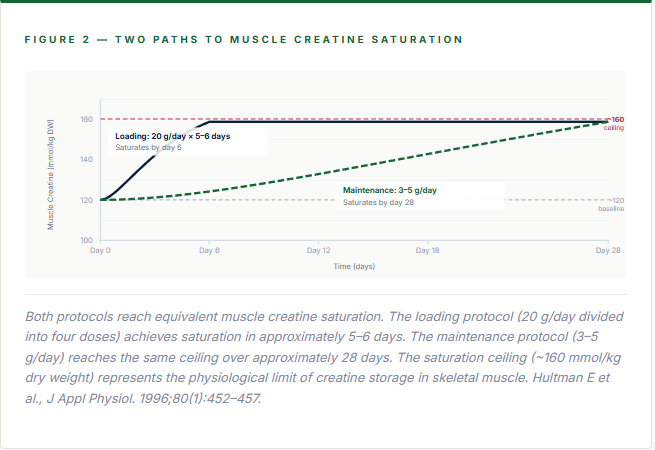
The foundational human loading study was published by Hultman and colleagues in the Journal of Applied Physiology in 1996. Their protocol — 20 grams of creatine monohydrate per day, divided into four 5-gram doses, for five to six days — produced an approximately 20% increase in total muscle creatine content, from a typical baseline of ~120 mmol/kg dry weight toward a saturated state near the physiological ceiling of ~160 mmol/kg. The same study demonstrated that the same final muscle creatine concentration could be achieved with a lower-dose maintenance protocol: approximately 3 grams per day for 28 days.
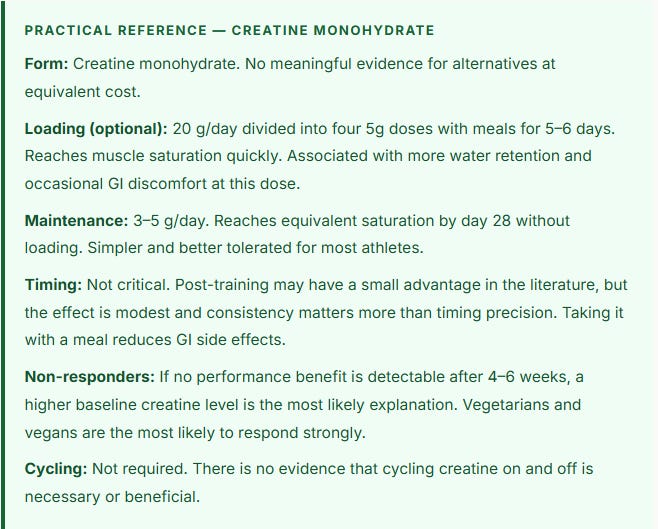
The clinical significance of the loading phase is speed, not magnitude. Both protocols produce equivalent muscle saturation — the loading phase simply reaches it in six days rather than four weeks. For an athlete preparing for a tournament within a week, loading has strategic value. For an athlete supplementing as part of year-round training, the maintenance approach is simpler, cheaper, and associated with fewer gastrointestinal side effects.
Responders, Non-Responders, and What Determines the Difference
Creatine supplementation does not produce uniform results across all individuals. Approximately 20–30% of people are classified as non-responders — individuals who show minimal increase in muscle creatine content following a standard supplementation protocol. The most likely explanation is that these individuals are already operating near their muscle creatine ceiling prior to supplementation. When baseline stores are already high, there is less room to fill, and the performance effect is correspondingly smaller.
The population most likely to respond strongly to creatine supplementation is vegetarians and vegans. Because plant foods contain negligible creatine, their baseline muscle creatine concentrations are lower than those of omnivores — often well below the saturation threshold. Supplementation therefore produces a larger absolute increase in muscle creatine and, in the research literature, tends to produce larger performance effects in plant-based eaters than in omnivores who already have some dietary creatine intake.
Among omnivores, individual variation in the creatine transporter (CrT1) and in baseline dietary intake are the primary determinants of where someone starts on the saturation curve and how much room exists for supplemental creatine to make a meaningful difference. There is currently no simple blood test that reliably predicts response prior to a trial. The practical approach is a 4-week maintenance protocol followed by an assessment of training performance — improvements in repeated sprint capacity, reduced fatigue on high-volume training days, or recovery improvements are consistent indicators of a meaningful response.
Forms — Why Monohydrate Is Still the Answer
The supplement market has introduced numerous creatine variants: creatine hydrochloride (HCl), creatine ethyl ester, buffered creatine (Kre-Alkalyn), creatine malate, and others. The argument typically made for each is that it offers superior bioavailability, better absorption, fewer GI side effects, or some combination thereof. The evidence does not support these claims as practically meaningful.
Creatine monohydrate is absorbed at greater than 99% efficiency. When the substrate being absorbed is already nearly complete, a 5–10% improvement in theoretical bioavailability per gram produces no meaningful difference in delivered muscle creatine. Creatine ethyl ester is the clearest case: a 2009 randomized controlled trial (Spillane et al.) found that serum creatine concentrations were actually higher in both the placebo and creatine monohydrate groups than in the ethyl ester group, with the ethyl ester being rapidly degraded to creatinine in the gut and therefore delivering less usable creatine to muscle. Creatine HCl is more water-soluble and shows a modestly higher bioavailability curve in pharmacokinetic studies, but when the baseline absorption rate for monohydrate is already above 99%, the practical difference in muscle creatine accumulation is negligible.
Decades of research, comprising hundreds of controlled trials, have been conducted on creatine monohydrate specifically. That body of evidence is the basis for every efficacy and safety conclusion in the literature. Purchasing a variant with less evidence for roughly the same or inferior outcome is not a decision the current science supports.
The Brain — Cerebral PCr and Cognitive Fatigue
The creatine transporter is not exclusive to skeletal muscle. It is expressed in neural tissue, and the brain maintains its own phosphocreatine reserve for the same reason muscle does: rapid ATP buffering under high-energy demand. Neurons, like muscle fibers, operate on ATP, and the demand spikes sharply during periods of intense cognitive processing.
Under normal rested conditions, cerebral creatine stores are sufficient for the demands of ordinary cognitive load. But under conditions that tax the brain’s energy reserves — prolonged cognitive effort, sleep deprivation, altitude, or the particular combination of physical and mental fatigue that accumulates over a long match — the cerebral PCr buffer can become a limiting factor. When cerebral PCr is depleted faster than it can be resynthesized, the downstream effect is cognitive fatigue: slower processing, degraded decision-making, reduced working memory, and impaired attentional control.
This is not speculative. A 2024 study published in Scientific Reports (PMC10902318) subjected 15 participants to 21 hours of sustained sleep deprivation in a controlled laboratory environment — a state that consistently produces measurable cognitive impairment — and administered a single high dose of creatine (0.35 g/kg body weight, approximately 25 g for a 70 kg individual) at hour 21. Within three hours of administration, participants showed significant improvements in short-term memory, processing speed, and the ability to perform logical and numerical tasks compared to a placebo condition. The effect peaked at approximately four hours post-dose and remained measurable for up to nine hours. Magnetic resonance spectroscopy confirmed corresponding changes in cerebral phosphocreatine and ATP ratios — the cognitive improvement had a measurable metabolic substrate.
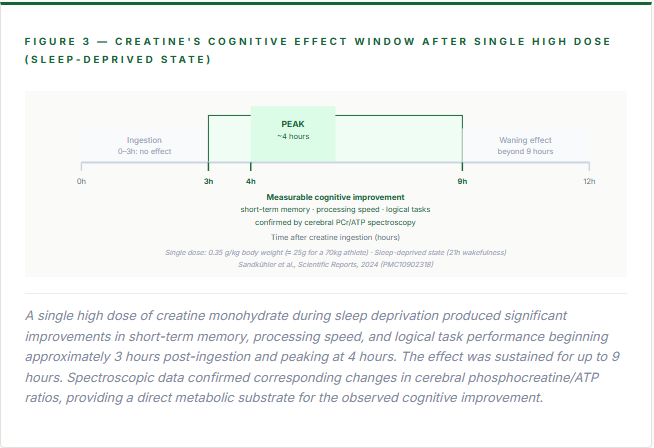
The tennis application is not difficult to draw. A three-set match in warm conditions lasting two hours or more depletes both physical and cognitive energy simultaneously. Late in a third set, the most important skill is often not the physical ability to produce racket head speed — it is the attentional control to execute a pattern under pressure, the working memory to read the opponent’s positioning, the processing speed to recognize a ball flight and commit to a shot before the window closes. If cerebral PCr depletion is contributing to deterioration in those capacities, creatine supplementation — through its effect on the brain’s own PCr reserve — addresses a variable that most performance programs do not touch.
It is worth being precise about what the current evidence does and does not show. The 2024 sleep deprivation study used a single large dose administered in a highly controlled deprivation state, not chronic supplementation in well-rested athletes. Chronic, low-dose supplementation likely provides a more modest and less acute cognitive buffer, not the acute reversal of severe sleep deprivation shown in the study. But the mechanism — cerebral PCr as an energy buffer under cognitive load — is real and demonstrated. The magnitude of the effect in a standard athletic context remains an active area of research.
Safety — Separating Evidence from Myth
Creatine supplementation has accumulated more safety data than perhaps any other dietary supplement. The most persistent concern is kidney damage — a worry based on the fact that creatine supplementation reliably elevates serum creatinine levels, and elevated serum creatinine is a clinical marker of kidney dysfunction. The confusion is understandable but incorrect, and it resolves cleanly with one distinction: serum creatinine is a metabolic byproduct of creatine metabolism in muscle. When creatine stores increase, more creatinine is produced and excreted — but this is a change in throughput, not a change in kidney function. When renal function is assessed using markers that actually reflect filtration capacity (eGFR, cystatin C, direct kidney function indices), creatine supplementation at recommended doses produces no detectable impairment in healthy individuals.
A 2025 systematic review and meta-analysis published in BMC Nephrology examined the available controlled trial evidence and found no significant effect of creatine supplementation on kidney function markers in healthy populations. Chronic supplementation of up to five years has been studied without evidence of cumulative renal harm. The kidney concern, for otherwise healthy individuals at standard dosing, is not supported by the evidence base.
The real side effects of creatine supplementation are more mundane. Water retention — an increase of 0.5–1.5 kg, primarily intracellular — is a consistent finding, particularly during loading phases. This is a physiological consequence of creatine’s osmotic effect on muscle cells, not a sign of harm. Some athletes find it relevant for weight-class sports; in tennis, it is typically irrelevant. Gastrointestinal discomfort — nausea or cramping — occurs in some individuals during loading (20 g/day divided doses), but is substantially less common at maintenance doses (3–5 g/day) and can often be avoided by taking creatine with meals rather than on an empty stomach.
One appropriate caution: individuals with pre-existing kidney disease have not been adequately studied in creatine trials. The evidence of safety applies to healthy individuals with normal renal function. Anyone with known kidney conditions should consult a physician before supplementing.
Conclusion
Creatine is not a supplement in the casual sense. It is a naturally occurring compound performing a well-characterized biological function — expanding the phosphocreatine reserve that ATP draws on during the first 8–10 seconds of every explosive effort, and which partially recovers during the 18–20 seconds between points. On a tennis court, where the ratio of high-intensity effort to recovery time governs who fatigues first, those kinetics are directly performance-relevant. The supplementation evidence — particularly for creatine monohydrate, particularly across the last three decades of controlled trials — is among the most robust in applied sport science.
The cognitive angle is newer and should be held at the appropriate level of certainty. The mechanism is real: the brain uses PCr as an energy buffer, and supplementation expands that buffer. The extent to which chronic low-dose supplementation translates to meaningful cognitive benefit in well-rested athletes in a match environment is an open question. The extent to which it matters under conditions of fatigue, travel, or multi-day tournaments is plausible and mechanistically grounded. It is a dimension of creatine’s profile that the athletic literature has underemphasized and that deserves more attention as the field catches up to the neuroscience.