


Picture the player everyone in the draw would rather avoid in the first two rounds — not the seed, not the most physically gifted, not the biggest serve. The player who doesn’t flinch at 5-5 in the third, who competes at the same intensity on point sixty as point one, who seems to draw something from difficulty that drains everyone else. That quality has been called composure, heart, competitive edge, mental toughness. These words describe the observation without explaining it. This piece is about the mechanism — what that quality is physiologically, where it lives in the brain and body, how it is actually constructed, and why the training environments that produce it often look unremarkable from the outside while those that fail to produce it frequently look sophisticated and well-resourced.
The First Principle of All Training
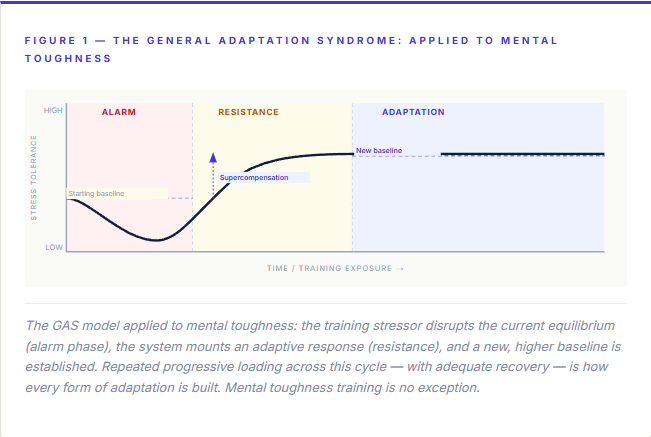
Hans Selye described the General Adaptation Syndrome in 1950, and it became the foundational framework for understanding all biological adaptation to stress. The sequence is deceptively simple. In the alarm phase, homeostasis is disrupted — the stressor exceeds the current capacity of the system. In the resistance phase, the body mounts an adaptive response. In the adaptation phase, the system stabilizes at a new, higher baseline: what periodization science calls supercompensation. This cycle, repeated with progressive loading and adequate recovery, is the mechanism behind every improvement a training program has ever produced in the history of organized athletic preparation.
Tennis coaches apply this framework to physical training load as a matter of routine. Increase volume too fast: alarm without recovery, injury or overtraining. Too slow: no alarm, no adaptation, stagnation. The right dose of the right stressor, timed correctly, produces growth. The argument this piece makes is not novel — it is the extension of a known biological principle to a system that coaches frequently treat as separate, as if it ran on different rails. Mental toughness is governed by the same first principle: stimulus, disruption, adaptation, new baseline. What changes between physical and psychological training is not the mechanism. It is the tissue being trained.
The aMCC: Where Willpower Lives in the Brain
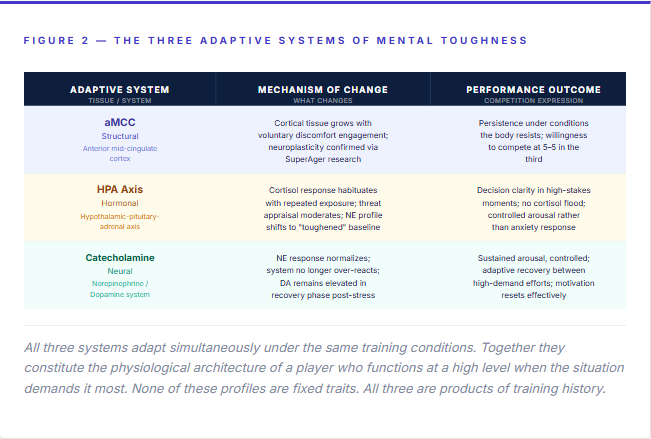
The brain region most directly associated with willpower, persistence, and what neuroscientist Andrew Huberman — citing the anatomy literature — has described as the “will to live” is the anterior mid-cingulate cortex (aMCC). Positioned at the intersection of cognition and motor control, the aMCC integrates emotional signals, body state, and the decision to continue or stop in the face of difficulty. What distinguishes it from willpower as a general concept is the specificity of its trigger: the aMCC responds to voluntary engagement with tasks the person does not want to do.
Research from the Northwestern SuperAger project provides some of the most compelling evidence for aMCC neuroplasticity. SuperAgers — individuals over 80 who maintain memory and cognitive performance equivalent to people decades younger — consistently show thicker anterior cingulate cortex tissue than age-matched controls. Their aMCC is structurally protected against the cortical thinning that typically accompanies aging, and their tissue contains a higher density of Von Economo neurons: large, specialized cells found primarily in the anterior cingulate that are associated with social cognition and self-regulation. The mechanism through which this tissue is maintained is not passive preservation. The SuperAger data indicates that continued engagement with cognitively and physically demanding tasks — the deliberate choice to do difficult things — maintains the neural architecture that makes persistence possible into very old age.
The practical implication is direct: the aMCC is not a fixed endowment. It responds to training stimulus. The athlete who is consistently exposed to manageable difficulty — and who chooses to engage with it rather than avoid it — is developing the neurological infrastructure of a competitor. This is not a metaphor. It is measurable tissue change driven by a specific and trainable input.
The Full Architecture: Three Systems Adapt Simultaneously
The aMCC is the structural component of mental toughness adaptation, but it does not operate in isolation. Two additional physiological systems adapt under the same training conditions, and together they constitute what exercise scientists call “physiological toughening” — a term coined by Richard Dienstbier in a landmark 1989 Psychological Review paper that remains the foundational framework for this entire area.
The first is the hypothalamic-pituitary-adrenal axis. Dienstbier documented that the cortisol response to a given stressor changes with repeated exposure. In untrained individuals, the first encounter with a high-stakes situation — a pressure match, extreme exertion, a performance-critical moment — produces a cortisol flood that impairs decision-making, narrows attention, and degrades fine motor control. In “toughened” individuals — those with systematic repeated exposure to comparable stressors — the same event produces a measured, functional response: sufficient arousal to enhance performance, without the destabilizing spike that floods the prefrontal cortex and produces exactly the kind of freeze, tighten, or over-try that determines close matches. Dienstbier’s model predicts that optimal performance under pressure requires high baseline norepinephrine, a rapid norepinephrine response, and a controlled cortisol profile. This profile is not innate. It is built.
The second is the catecholaminergic system. Research from military SERE (Survival, Evasion, Resistance, Escape) training environments has measured norepinephrine and dopamine responses before, during, and after intensive high-stress training periods. The adaptive pattern: norepinephrine response habituates — the system no longer over-reacts to a stressor it has encountered repeatedly — while dopamine remains elevated during the recovery phase. This is the neural signature of the trained competitor: a system that mobilizes effectively, does not flood, and recovers motivation quickly between high-demand efforts.
The Tools Are Homeostasis Disruptions
The stimuli that drive adaptation across all three systems are, structurally, disruptions of homeostatic states. The cold morning when the body wants the warm bed. The cold shower when every signal says warm water. The session on the outdoor court in November rain when the body would choose the climate-controlled environment. The third hour of footwork when the signals urging rest have been present for forty minutes. The hundred serves after two hours of play when each repetition wants to be slightly abbreviated because the shoulder aches and the arm is heavy.
None of these require cruelty, screaming, or fear. Each is a controlled disruption of a homeostatic preference — a stressor in the Selye sense, activating the alarm phase of the GAS cycle. More precisely: the athlete’s voluntary choice to engage with the disruption is the specific signal to the aMCC. Getting up anyway, getting under the cold water, running in the rain — the decision to engage rather than avoid — is the active ingredient. The discomfort is the vehicle. The voluntary engagement is the training stimulus.
This is also why structure and discipline carry developmental weight that goes beyond behavioral compliance. Standing precisely in a required stance. Arriving on time when sleep-deprived. Maintaining a specific standard of conduct in a fatiguing environment. Each small demand is a low-level homeostasis disruption — the body would prefer the easier alternative — with a voluntary engagement component. Accumulated across months and years, these small signals generate the same adaptive cascade that the larger physical stressors produce. The military understood this intuitively before neuroscience could explain it: the insistence on posture, protocol, and precision under conditions of physical discomfort is not arbitrary formalism. It is stimulus stacking.
The Critical Misattribution
Many coaches and parents observe the external form of demanding training environments — the drill sergeant’s screaming, punishment runs, emotional pressure, arbitrary difficulty imposed through aggression — and conclude that the aggression or fear is the mechanism. This is almost certainly wrong, and the error produces two failure modes that are both common and opposite in kind.
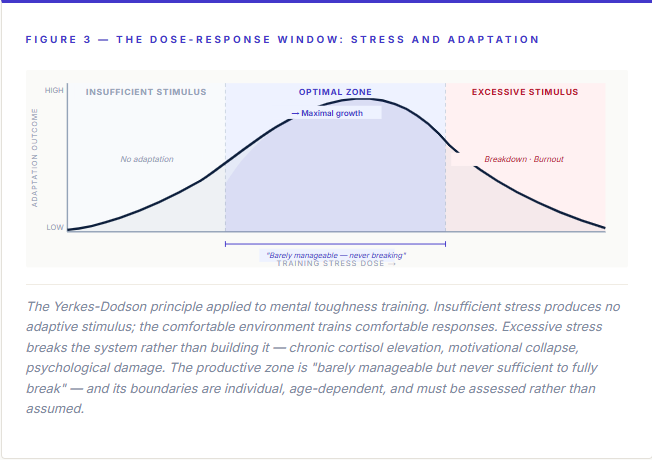
The first is under-stimulus: the protective environment that removes the stress stimulus (hardship, uncertainty, scarcity etc.) before the athlete encounters it, that prioritizes confidence above challenge at every decision point, that never creates a genuine alarm-phase stressor because the coach or parent intervenes to smooth the path. This environment cannot produce mental toughness because it never provides the training signal. The athlete may emerge technically competent and situationally fragile — capable of high performance when conditions are comfortable, unable to access that performance when they are not. The protection they received was, in that specific sense, a deprivation.
The second failure mode is excessive stimulus: the environment that mistakes chronic stress for progressive overload, or that uses fear and psychological pressure in ways that produce avoidance motivation rather than voluntary engagement. The Yerkes-Dodson principle applies here as directly as it applies to physical training load. At some point the stressor exceeds the window of productive adaptation and instead produces system breakdown — chronic cortisol elevation, loss of intrinsic motivation, psychological damage that undermines the trust in the environment that makes deliberate discomfort engagement possible. Breaking the athlete is not toughening the athlete. It is the failure state.
Progressive Overload for the Mind
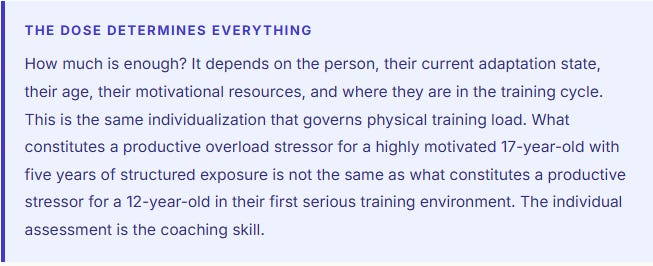
The toughening process is not an event. It is a progression governed by the same periodization logic that governs physical development — and it operates on a comparable timeline: years, not weeks. The sessions that represent a genuine alarm-phase stressor for a fourteen-year-old two years into systematic training are well within the adapted capacity of a seventeen-year-old who has had four years of progressive exposure. The aMCC has grown. The HPA axis has habituated to that level of stressor. The catecholamine system has normalized. The dose that was “barely manageable” in year two is recovery territory by year four. The stimulus must progress as the system adapts, or adaptation stalls — exactly as it does in physical training when loads are never increased.
The overload principle applies identically. The recovery principle applies identically. The specificity principle applies identically: you build stress tolerance for the conditions you repeatedly encounter, which is why training environments that create match-like pressure develop match composure, while training environments that never create pressure do not. The variables are managed with the same intelligence — the same attention to readiness, to individual state, to where the athlete is in their development cycle. What looks like “hard” from outside the understanding is, inside it, a tool manipulated for a specific physiological purpose. The difference between a skilled coach and one who is simply demanding is that the skilled coach knows which purpose they are serving and is deliberately calibrating the stimulus to serve it.
What This Looks Like in Tennis
In a development environment that builds mental toughness, the elements are recognizable and unremarkable from the outside. Pre-dawn sessions in winter when the combination of cold, darkness and early hour, or the Texas heat middle of the summer at 1 pm, create stressors that are manageable only because the athlete has built toward it across months or perhaps years. The coach who holds the standard on ball toss execution when the player is exhausted and every instinct wants release — not out of rigidity, but because the moment of exhausted imprecision is precisely where the standard matters most for the development it is producing. The practice set at 4-4 where pressure is escalated rather than diffused. The lift or better yet long run at the end of the grueling summer day, in the blistering heat, that is where the athlete is slowly forged, day by day, month by month, year by year, and there is no easy way around it.
None of this is neuroscience visible to the observer. From inside the understanding, it is exactly that: a sequence of homeostasis disruptions, each calibrated to the athlete’s current adaptation state, progressively loaded across the years of their development, designed to build the three-system architecture that determines what they can do when the match demands everything and everything in their body is arguing for less.

The coach who never challenges the player is not protecting them. They are depriving them of the only experience that builds what determines performance at 5-5 in the third. The hard training environment and the genuinely caring training environment are not opposites. A coach who understands the mechanism cares deeply enough to provide the necessary stimulus, manages the dose with the same intelligence they bring to physical load planning, and builds it progressively across the years of a development program. That is not hardness for its own sake. It is the deliberate application of the first principle of all training adaptation — extended, finally, to the tissue where competitive performance is ultimately decided.

This is a great topic applicable to life beyond just athletics. Though it’s certainly a make or break in sport. There is something to be said about the thousand-foot perspective of recognizing mental toughening as a process. As a form of the same adaptation process we use for other tissues in the body, for the brain. I think that can help create some acceptance in the challenge that comes with making the decision to choose that intentional disruption.
Really great breakdown!
Learn something new every time I read! Thank you