There is a phrase embedded in athletic culture so deeply that correcting it feels almost impolite: “lactic acid buildup.” Every athlete who has ever trained hard has experienced the burn — the sensation that accumulates in working muscles during intense effort, the heaviness, the slowing, the feeling that the muscle is fighting against itself. And the explanation handed down from coaches and locker rooms and half-remembered physiology classes is always the same: lactic acid. You have to flush the lactic acid. Run it out. Shake it off. The problem is that this explanation is biochemically wrong — and the correction is not a minor technicality. Understanding what actually causes glycolytic fatigue changes how you think about supplementation, recovery, and the specific demands of a long tennis match in heat.
The Real Mechanism — H⁺ Accumulation, Not Lactate
Lactate is produced in enormous quantities during high-intensity exercise. It is a byproduct of anaerobic glycolysis — the metabolic pathway that breaks down glucose for ATP when oxygen delivery cannot keep pace with energy demand. But lactate itself is not the fatigue-causing agent. The confusion arises because lactate production and hydrogen ion (H⁺) accumulation occur simultaneously, making it easy to correlate the wrong variable with the outcome.
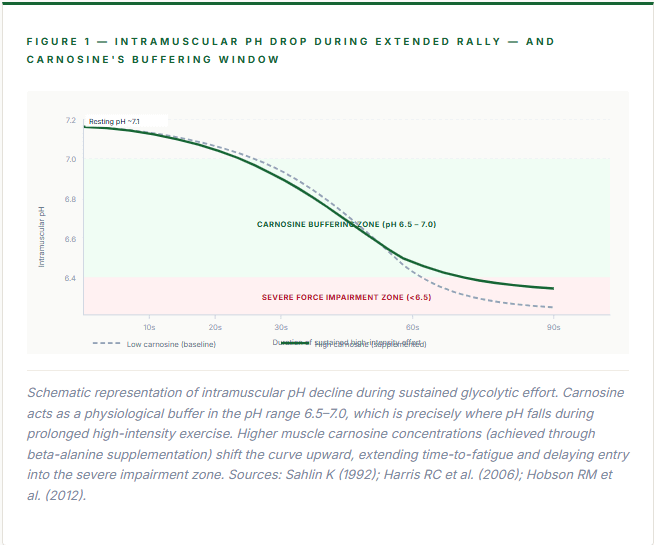
The actual culprit is intramuscular acidosis — a drop in pH caused by H⁺ accumulation. During glycolysis, ATP hydrolysis (the reaction that actually does the mechanical work) releases H⁺ ions. As work rate increases and ATP turnover accelerates, H⁺ production exceeds the buffering capacity of the muscle, pH drops, and several things go wrong simultaneously. Enzyme function is impaired — the contractile proteins actin and myosin become less sensitive to calcium. Ion transport mechanisms slow. The cross-bridge cycling rate that generates force decreases. At a cellular pH of roughly 6.5 (normal resting pH is ~7.1), muscle force production can fall by 30–40%.
Lactate, in fact, is now understood to be something of a metabolic ally. It can be transported out of the working muscle, taken up by adjacent fibers, cardiac muscle, and the liver, and used as a fuel substrate. Far from a waste product to be purged, lactate is an energy carrier — a finding that has reshaped sports science since George Brooks’ lactate shuttle hypothesis was published in the 1980s and since confirmed repeatedly. The phrase “lactic acid buildup” is a fossil from an older model that the evidence has moved beyond.

What all of this means practically is that the fatigue of repeated high-intensity glycolytic effort is, to a meaningful degree, a pH management problem. The body has endogenous buffering systems — bicarbonate in the blood, phosphate in the muscle, and most relevantly for supplementation, carnosine inside muscle fibers. The question is whether those buffers can be expanded. The answer, with some compounds, is yes.
Beta-Alanine — The Rate-Limiting Precursor to Carnosine
Carnosine (beta-alanyl-L-histidine) is a dipeptide — a molecule formed from two amino acids: beta-alanine and histidine. It is found in high concentrations inside Type II (fast-twitch) muscle fibers, which are the fibers most heavily recruited during explosive and high-intensity glycolytic effort. Carnosine functions as an intramuscular proton buffer, accepting H⁺ ions within the physiologically relevant pH range of 6.5–7.0 — precisely the range in which pH falls during hard exercise. It also has secondary roles in calcium sensitivity and antioxidant activity, though the buffering function is the primary performance-relevant mechanism.
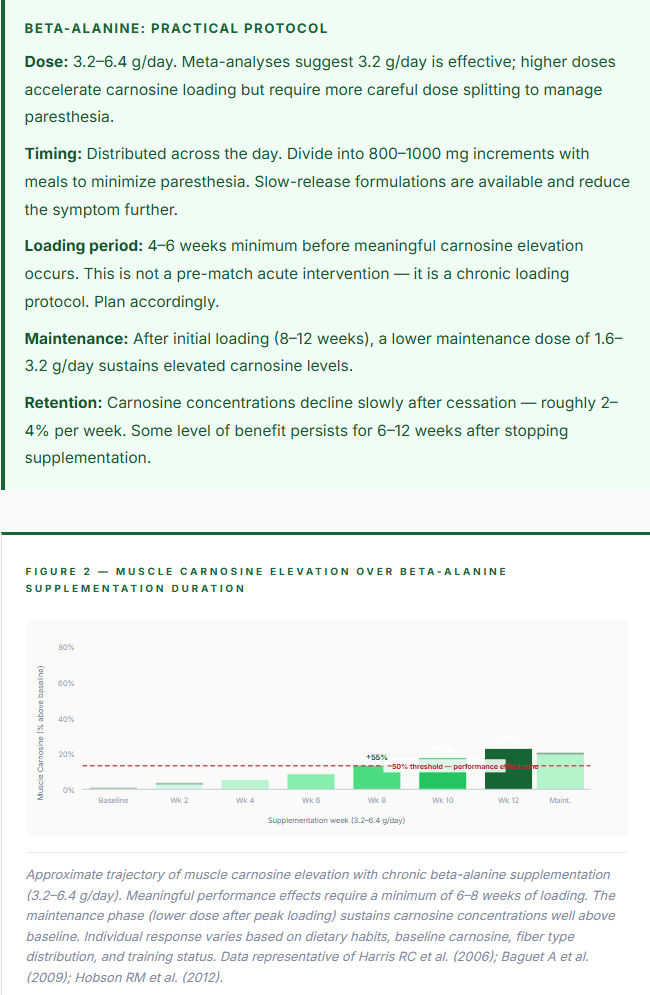
The muscle carnosine level in a given individual is determined primarily by how much beta-alanine is available. Histidine, the other precursor, is abundant from dietary protein and is not limiting. Beta-alanine is the bottleneck. Supplementing beta-alanine directly — bypassing the question of whether carnosine itself can be absorbed intact from the gut (it cannot efficiently cross intestinal membranes) — increases intramuscular carnosine concentrations in a dose-dependent and cumulative manner.
The Evidence
The foundational beta-alanine work came from Roger Harris and colleagues in the early 2000s, the same researcher who established the creatine loading protocol. The 2006 paper in Amino Acids demonstrated that beta-alanine supplementation at 3.2–6.4 grams per day for 4–10 weeks produced mean muscle carnosine increases of 40–80%, with higher doses and longer durations producing greater elevation. The carnosine increase is retained for weeks after supplementation ceases, with concentrations declining slowly over several weeks.
A 2012 meta-analysis by Hobson and colleagues (sixteen studies, 360 participants) found a statistically significant effect of beta-alanine on exercise outcomes, with the effect size largest for exercise bouts of 60–240 seconds in duration — the domain of extended rally sequences and tiebreak play in tennis. Shorter explosive bouts (<60 seconds) showed smaller effects, consistent with the mechanism: at those durations, the PCr system handles most of the energy demand and pH does not fall far enough for carnosine to be the limiting variable. Beyond 4 minutes, the aerobic system dominates and pH buffering capacity becomes less decisive. The sweet spot for beta-alanine is the glycolytic middle zone — intense efforts lasting roughly one to three minutes.
Paresthesia — What It Is and Whether to Be Concerned
Beta-alanine has a well-characterized and universal side effect: tingling, most commonly in the skin of the face, neck, and hands. The sensation — called paresthesia — arises because beta-alanine activates specific nerve receptors (Mas-related G protein-coupled receptor D, or MrgprD) in cutaneous nerves. It is harmless. It is also universal at doses above approximately 800–1000 mg per bolus.
The paresthesia is dose-dependent and can be managed in two ways: by dividing doses to 800–1000 mg or less (four to eight doses spread across the day rather than one or two large ones), or by using slow-release formulations. The paresthesia does not persist with chronic use — most athletes report adaptation within two to three weeks. It should not be mistaken for an adverse effect; it is a predictable pharmacological response that says nothing about whether the supplementation is working or safe.
Sodium Bicarbonate — Extracellular Buffering
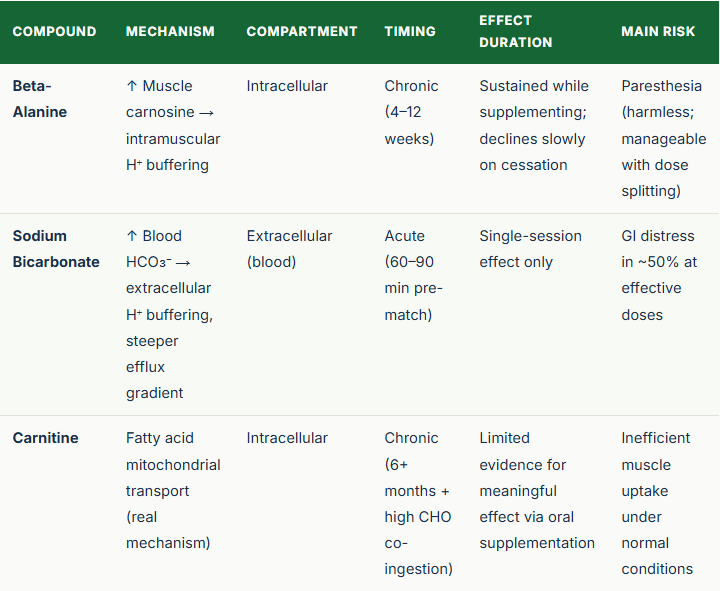
While beta-alanine works inside the muscle cell, sodium bicarbonate works in the blood. This is the distinction that separates the two primary buffering interventions — they operate in different compartments, through different mechanisms, and can in principle be combined without interference.
Disclaimer before moving forward, this is not a suggestion to consume Sodium bicarbonate for athletic performance, in fact, I would highly discourage any attempt to use the following as ergogenic aid!
Sodium bicarbonate (NaHCO₃, baking soda) is the body’s primary extracellular buffer. When H⁺ ions produced in working muscle are transported out of the cell via monocarboxylate transporters into the bloodstream, blood bicarbonate serves as the first line of defense — accepting the protons and preventing blood pH from falling. The reaction is:
H⁺ + HCO₃⁻ → H₂CO₃ → H₂O + CO₂
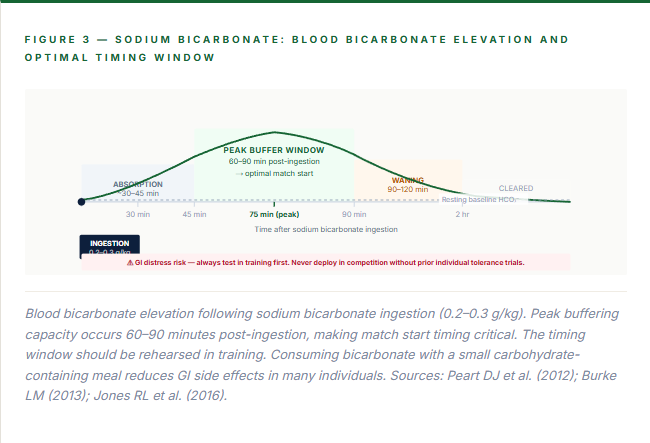
Ingesting sodium bicarbonate before exercise raises blood bicarbonate concentrations, increasing the buffering capacity available for H⁺ efflux from working muscle. This steepens the H⁺ gradient across the muscle cell membrane, which accelerates H⁺ efflux, which in turn slows intramuscular pH decline. The net effect is that glycolytic fatigue is delayed — not eliminated, but pushed further into the future.
The Evidence
A 2012 meta-analysis by Peart and colleagues reviewed 35 studies and found a moderate positive effect of sodium bicarbonate on high-intensity exercise performance, with effect sizes in the small-to-moderate range. The effects are most consistently demonstrated in exercise bouts of 1–7 minutes — again, the glycolytic domain. Effects on sprint performance of less than 60 seconds are less consistent, and effects on aerobic exercise exceeding 10 minutes are minimal.
The optimal dose is 0.2–0.3 grams per kilogram of body mass, consumed 60–90 minutes before exercise to allow blood bicarbonate to reach peak concentration. A 70 kg athlete would consume 14–21 grams — roughly one to one and a half tablespoons dissolved in water, often with a small carbohydrate-rich meal to slow absorption and reduce gastrointestinal side effects.
The GI Problem
Sodium bicarbonate’s most significant practical limitation is gastrointestinal distress. At effective doses, roughly 50% of individuals experience nausea, bloating, stomach cramping, or diarrhea severe enough to impair performance. This is not a minor inconvenience — it is a real risk in a match context that must be weighed against the buffering benefit. Strategies to mitigate GI distress include consuming bicarbonate with food, using sodium citrate as an alternative salt (with similar mechanism but slightly better GI tolerance in some individuals), splitting the dose, and extensive individual practice before deploying it in competition.
This last point deserves emphasis and reiteration. Sodium bicarbonate is not something to attempt for the first time on match day. Every athlete responds differently. The GI profile must be established in training, across multiple trials, at the intended dose and timing, under match-like conditions. Only after confirming tolerance in practice, may deployment potentially be appropriate.
Carnitine — Separating Mechanism from Marketing
L-carnitine is included in almost every pre-workout, every “fat burner,” and a significant fraction of the general supplement market. The mechanism it is marketed on is real: carnitine is required for the transport of long-chain fatty acids across the inner mitochondrial membrane, where they are oxidized for energy. Without carnitine, fat cannot enter the mitochondria and be burned. This is not a fabricated claim — it is basic biochemistry.
The problem is the inference that supplementing carnitine will therefore increase fat oxidation during exercise and improve performance. That inference is wrong for a specific reason: the limiting factor in fat oxidation during exercise is not carnitine availability. In healthy individuals consuming a normal diet, muscle carnitine concentrations are close to saturated. Oral L-carnitine supplementation does not meaningfully increase muscle carnitine levels, because the regulatory mechanisms controlling carnitine uptake into muscle are not driven by plasma concentration under normal conditions.
The 2011 work by Wall and colleagues in the Journal of Physiology demonstrated that co-ingesting carnitine with a high dose of insulin (via carbohydrate) over 24 weeks could increase muscle carnitine content by approximately 21%. This is the only human protocol demonstrated to actually raise muscle carnitine, and it requires very large carbohydrate loads twice daily for six months. The practical applicability to a tennis athlete’s supplementation protocol is limited.
There is emerging interest in L-carnitine L-tartrate for recovery — primarily related to reducing exercise-induced muscle damage markers — and in propionyl-L-carnitine for vascular function. These are preliminary lines of inquiry with much smaller evidence bases than beta-alanine or sodium bicarbonate. The summary position on carnitine is: the mechanism is real, the supplementation delivery is inefficient under normal conditions, and the evidence for meaningful performance effects in well-nourished athletes is weak. Carnitine is not in the same evidence tier as the buffering interventions covered in this article.
The Tennis-Specific Case
The glycolytic system is primary from approximately the 10-second to 90-second mark of continuous effort. On a tennis court, that window corresponds to a specific and repeatedly occurring situation: the extended rally. Baseline exchanges on clay — where surface speed is lower, rally length is longer, and the match itself extends in time — regularly push into the 20–40 second range. Long games in heat. Third-set tiebreaks. Service games on break point. These are not abstract scenarios; they are the moments that decide matches.
What distinguishes a player with high muscle carnosine from one with low carnosine during a 45-second grinding clay baseline rally is not speed on any individual stroke. It is the cumulative effect of that rally on the buffer that protects every subsequent stroke and every subsequent point. The burn arrives later. The first-step stays quicker. The decision-making overhead of a fatiguing body — which pulls cognitive resources from tactical processing — is delayed.
Sodium bicarbonate operates in the same window but via a different mechanism, and its timing dependency makes it a more tactically specific intervention. A match that is scheduled for a fixed time — a tournament draw, a scheduled court assignment — allows the timing window to be pre-planned with a precision that a long training session does not. This is actually an advantage for competitive athletes over training-only users: you know when the match starts.
Heat as a Compounding Variable
Heat accelerates glycolytic flux. In high ambient temperature, even moderate-intensity work requires greater glycolytic contribution — the aerobic system’s efficiency decreases, thermoregulatory demands compete with skeletal muscle for blood flow, and overall glycogen utilization increases. pH management, already important in temperate conditions, becomes more critical in heat. Athletes playing summer clay-court tournaments, particularly in European summer heat, face an environment where both the rate of H⁺ production and the total duration of play create ideal conditions for buffering capacity to become performance-limiting.
The Combined Protocol
Beta-alanine and sodium bicarbonate can be stacked. They act in different compartments (intracellular versus extracellular), through different mechanisms, and there is no pharmacological conflict between them. The 2013 review by Carr and colleagues and subsequent work suggests at minimum additive effects when combined, with some studies showing synergy — the combined intervention producing larger improvements than the sum of each alone would predict. The combination is logistically more complex (requiring concurrent chronic loading of beta-alanine and acute pre-match bicarbonate dosing), but is supported by the mechanistic rationale.
What Is Not Covered Here — and Why
This article focuses on the mechanisms of pH buffering, the evidence for beta-alanine and sodium bicarbonate specifically, and the tennis application. It does not address ergogenic aids whose primary mechanism is not buffering — caffeine, creatine, nitrates, and others are addressed in dedicated articles in this series, where the mechanism, evidence, and application are treated with the space they deserve.
Carnosine supplementation itself — rather than its precursor beta-alanine — has been studied, and the barrier to effective oral delivery (carnosine is largely degraded in the gut and bloodstream by carnosinases before reaching muscle in meaningful quantities) is why beta-alanine remains the standard intervention for raising muscle carnosine. Intramuscular injection of carnosine would bypass this, but is not a practical supplementation route. Some research on dipeptide forms and modified carnosine analogs exists but is not at a stage of development relevant to current practice.
Conclusion
The glycolytic buffering story is one of the most mechanistically satisfying in applied sport science: identify the actual fatigue molecule (H⁺, not lactate), find the endogenous buffering system (carnosine), identify the rate-limiting precursor (beta-alanine), demonstrate that supplementing the precursor chronically elevates the buffer, show that performance in the relevant duration domain improves, and confirm the mechanism through a parallel extracellular intervention (sodium bicarbonate) that works through a complementary pathway. Each step is supported by human data from controlled trials.
For a tennis player specifically, the practical takeaway is this: the glycolytic middle zone — efforts lasting 30 seconds to 3 minutes — is both the mechanistic sweet spot for buffering interventions and the domain in which many matches are decided. Third-set tiebreaks, extended clay baseline rallies, long service games under pressure — these are not random occurrences. They are predictable features of competitive tennis at every level. If you are going to invest in the chronic loading protocol that beta-alanine requires, that is the context you are loading for.