In 1980, Robert Furchgott published an experiment showing that the neurotransmitter acetylcholine caused blood vessels to dilate — but only when the inner lining of the vessel, the endothelium, was intact. Remove the endothelium, and the same chemical caused constriction instead of relaxation. Something the endothelium was producing controlled the vessel’s response to chemical signals. Furchgott called it endothelium-derived relaxing factor, EDRF. Eight years later, Louis Ignarro and Ferid Murad independently identified EDRF as nitric oxide — a gas, a free radical, a molecule with a half-life measured in seconds. In 1998, the three of them shared the Nobel Prize in Physiology or Medicine. Nitric oxide, it turned out, was not just a vascular signaling molecule. It governed immune function, neurotransmission, platelet aggregation, and mitochondrial respiration. It was, in a phrase that has been used so many times it has become cliché, one of the most important molecules in human biology.
Sport nutrition arrived at this story through a narrower door: the observation that improving blood flow to working muscle should, in principle, improve oxygen delivery, nutrient supply, and metabolite clearance during exercise — and that a molecule regulating vessel diameter was a plausible target. The supplement industry arrived at the same story simultaneously, which is why the term “nitric oxide booster” has been a staple of pre-workout marketing since the early 2000s. The science and the marketing diverged substantially on the details. Understanding what actually happens when you supplement with L-arginine versus L-citrulline versus dietary nitrate, and what the evidence shows for performance in real athletes in real protocols, requires disentangling a physiology that is considerably more complex than most product labels acknowledge.
The Molecule — What Nitric Oxide Does in the Body
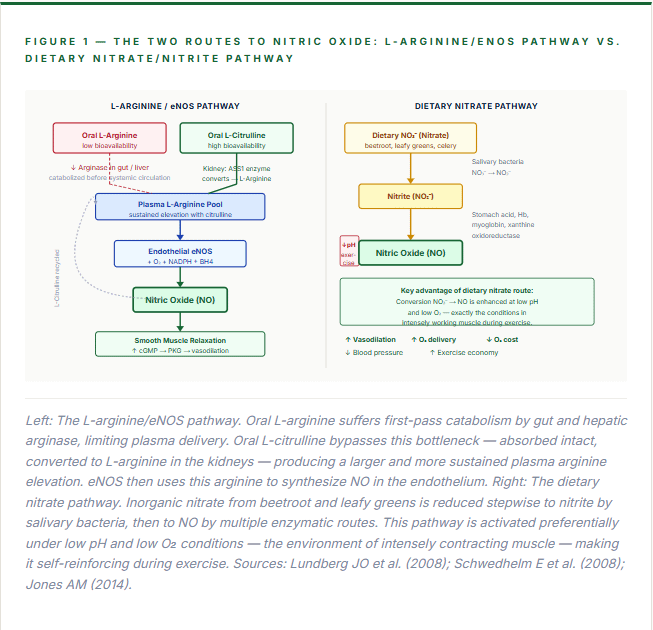
Nitric oxide (NO) is synthesized endogenously from the amino acid L-arginine in a reaction catalyzed by a family of enzymes called nitric oxide synthases (NOS). In the context of vascular function, the relevant isoform is endothelial NOS, abbreviated eNOS. The reaction is: L-arginine + O₂ + NADPH → NO + L-citrulline + NADP⁺. The reaction requires several cofactors — tetrahydrobiopterin (BH4), calmodulin, and flavin nucleotides — and is triggered when mechanical shear stress (blood flowing across the endothelial surface) or chemical agonists (acetylcholine, bradykinin, insulin) activate eNOS.
Once synthesized, NO diffuses across the endothelial cell membrane into the adjacent smooth muscle. There it activates soluble guanylate cyclase, which converts GTP to cyclic GMP. The rise in cGMP activates protein kinase G, which phosphorylates myosin light-chain kinase, reducing its activity and causing smooth muscle relaxation. The vessel dilates. More blood moves through. The entire cascade from eNOS activation to measurable vasodilation takes less than a second.
Beyond vasodilation, NO exerts effects that are directly relevant to exercise physiology: it reduces the oxygen cost of mitochondrial respiration (allowing a given amount of ATP to be produced with less oxygen consumed), inhibits platelet aggregation and leukocyte adhesion to the endothelial wall, and modulates mitochondrial biogenesis through downstream effects on PGC-1α. These are not peripheral footnotes. The oxygen-cost reduction alone — demonstrated in multiple beetroot juice trials — has measurable implications for exercise economy, the efficiency with which the body converts oxygen to mechanical work.
The L-Arginine Problem
The first generation of “nitric oxide boosters” — dominant in the early 2000s — was built almost entirely on L-arginine supplementation. The logic was simple: L-arginine is the substrate for eNOS, so more L-arginine should produce more NO. The problem is that this logic ignores the pharmacokinetics of orally ingested L-arginine.
When L-arginine is consumed orally, a significant fraction is catabolized in the gut and liver before reaching systemic circulation. The enzyme responsible is arginase — the same enzyme that competes with NOS for L-arginine in peripheral tissues — and it is highly expressed in enterocytes and hepatocytes. The result is that oral L-arginine supplementation at typical doses (3–6 g) produces only modest increases in plasma L-arginine concentration, and these increases are not reliably sufficient to drive meaningful additional NO synthesis in vascular endothelium that is already supplied with arginine from endogenous synthesis and other sources.
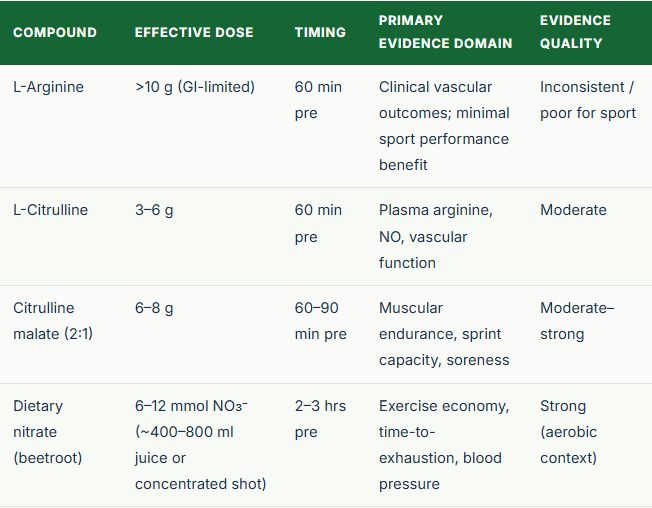
At higher doses (≥10 g), oral L-arginine begins to overcome the first-pass effect — but at a cost. High-dose L-arginine reliably causes significant gastrointestinal distress: bloating, cramping, and diarrhea. This is partly because the amino acid activates the same osmotic mechanisms as high-dose magnesium, drawing water into the gut lumen. The net result for athletes is that L-arginine is largely ineffective at tolerable doses and intolerable at effective doses. The numerous clinical and sport science trials of L-arginine supplementation show a mixture of null results and modest effects, with effect sizes typically smaller than the evidence for citrulline or dietary nitrate.

The Citrulline Solution — Bypassing First-Pass Metabolism
L-citrulline is an amino acid produced as a byproduct of the eNOS reaction itself (L-arginine → NO + L-citrulline). It is not a protein amino acid — it does not appear in dietary protein in meaningful amounts, but is found in significant concentrations in watermelon and watermelon rind. More relevantly for supplementation: L-citrulline has markedly different pharmacokinetics than L-arginine.
Citrulline is absorbed in the small intestine and reaches the kidneys largely intact, bypassing the hepatic first-pass arginase catabolism that limits L-arginine bioavailability. In the kidneys, citrulline is converted back to arginine via the enzyme argininosuccinate synthase (ASS1), and this newly synthesized arginine enters systemic circulation. The result is that oral citrulline supplementation produces a more sustained, larger increase in plasma arginine concentration than an equivalent dose of oral L-arginine — a counterintuitive finding that has been replicated consistently since its initial description in the 1990s.
The form most studied in sport science is citrulline malate — citrulline combined in a 2:1 ratio with malic acid. Malic acid is a tricarboxylic acid cycle intermediate, and while some researchers have proposed that it contributes independently to performance through energy metabolism effects, the evidence for a malate-specific contribution is limited. The primary active component is citrulline; the malate appears to facilitate citrulline’s tolerability and may have modest effects on aerobic energy production independently.
The Performance Evidence — What the Research Shows
Dietary Nitrate and Exercise Economy
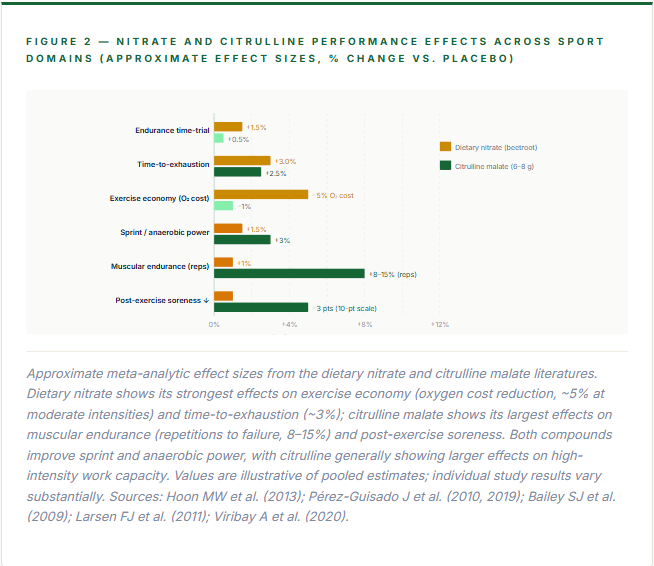
The strongest and most consistently replicated performance evidence in this area comes from dietary nitrate supplementation via beetroot juice or sodium nitrate. A landmark 2009 paper by Bailey and colleagues showed that beetroot juice supplementation (approximately 500 ml daily for 6 days, providing ~6.4 mmol nitrate) reduced the oxygen cost of submaximal cycling by approximately 19% compared to placebo. The same workload required measurably less oxygen — an improvement in exercise economy that is unusual in magnitude for a nutritional intervention and that translates directly to performance when aerobic capacity is the limiting factor.
This finding was replicated and extended across cycling, running, and rowing. A 2011 study by Lansley and colleagues showed that a single 500 ml dose of beetroot juice improved 4 km and 16.1 km cycling time-trial performance by approximately 2.8% and 2.7% respectively compared to nitrate-depleted beetroot juice (a placebo that matched taste, color, and sugar content while removing the active nitrate). A 2014 meta-analysis by Hoon and colleagues reviewing 17 randomized crossover trials found a mean improvement in time-to-exhaustion of approximately 3% and a mean improvement in time-trial performance of approximately 1.5%, with larger effects at moderate intensities (below VO₂max) than at near-maximal intensities.
The mechanism for the exercise economy improvement is well-established: NO reduces the activity of the mitochondrial complex I and IV, paradoxically improving the efficiency of oxidative phosphorylation — allowing more ATP to be generated per unit of oxygen consumed. This is distinct from the vasodilatory effect (which improves oxygen delivery) and operates in the opposite direction: it reduces oxygen demand. Both effects are beneficial for sustained aerobic performance.
Citrulline Malate and High-Intensity Work Capacity
The evidence for citrulline malate is concentrated in high-intensity and resistance exercise rather than aerobic endurance, which makes it particularly relevant to intermittent sport athletes — including tennis players. A widely cited 2010 study by Pérez-Guisado and Jakeman found that 8 g of citrulline malate, taken one hour before a bench press protocol, increased repetitions to failure by 52.9% compared to placebo, with significant reductions in muscle soreness 24 and 48 hours post-exercise. The effect sizes in this study are unusually large and have been criticized for methodological reasons (might warrant critical analysis and review), but the directional finding — improved high-intensity work capacity — has been replicated in multiple subsequent trials.
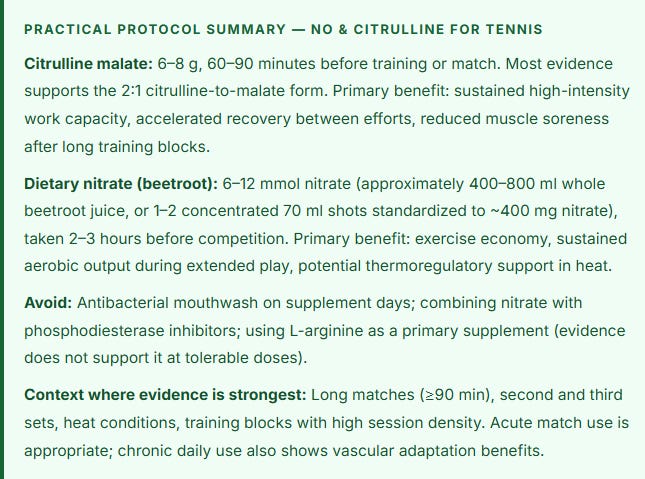
A 2019 meta-analysis by Pérez-Guisado reviewed 12 randomized trials and found significant improvements in both upper- and lower-body muscular endurance with citrulline supplementation, with effect sizes ranging from small to moderate. A 2020 systematic review by Viribay and colleagues found consistent evidence for improved anaerobic performance and time-to-exhaustion at high-intensity work rates, with the strongest effects at doses of 6–8 g taken 60–90 minutes before exercise.
The mechanism for citrulline’s benefit at high intensities is likely multi-factorial: improved blood flow via the NO pathway accelerates oxygen delivery and metabolic waste clearance (lactate, H⁺, inorganic phosphate) during intense effort; the citrulline/arginine cycle also participates in ammonia detoxification, which may reduce central fatigue signaling; and malic acid as a TCA intermediate may modestly support aerobic energy production during the recovery between high-intensity efforts.
Tennis-Specific Considerations
Tennis is an intermittent sport — characterized by explosive bursts of 5–10 seconds interspersed with 15–25 second recovery periods between points, with longer rest between games and changeovers, across matches that typically last 60–180 minutes. This structure places different demands on the NO system than sustained endurance exercise. The direct translation of beetroot juice evidence from cyclists to tennis players requires some care.
What the intermittent structure of tennis does suggest is a role for citrulline’s specific profile: the improvements in muscular work capacity during repeated high-intensity efforts, and the acceleration of recovery between efforts, are mechanistically aligned with the demands of rally play. A player who can sustain higher contractile force per rally and recover more completely between points across a 2-hour match has a meaningful advantage — and these are the parameters citrulline most consistently improves in the literature.
The beetroot juice / dietary nitrate evidence is more directly applicable in two scenarios: matches played in heat (where vascular thermoregulatory demands compete with muscular blood flow needs, and NO-driven vasodilation supports both), and extended third-set play where aerobic recovery between changeovers becomes a limiting factor. A 2017 study by Thompson and colleagues specifically examined dietary nitrate supplementation in tennis-relevant intermittent exercise protocols, finding significant improvements in sprint speed, reaction time, and repeated sprint recovery at doses of 6 mmol nitrate. This is the most ecologically valid evidence available for this population.
L-Arginine vs. Citrulline — The Supplementation Evidence Directly Compared
The clearest head-to-head comparison of L-arginine and L-citrulline for plasma arginine elevation was conducted by Schwedhelm and colleagues (2008), who showed that 3 g of oral citrulline produced a greater and more sustained increase in plasma arginine concentration than 3 g of oral L-arginine — a finding that contradicts the first-principles prediction from substrate biochemistry but is entirely consistent with the first-pass metabolism pharmacokinetics described above.
For performance outcomes, a 2020 meta-analysis by Trybulski and colleagues synthesizing 18 trials found that citrulline supplementation significantly improved exercise performance across multiple domains, while a parallel analysis of L-arginine trials found inconsistent and generally smaller effects. The consensus position in current applied sport nutrition is that L-arginine supplementation at typical doses provides minimal reliable ergogenic benefit for healthy athletes, while citrulline malate at 6–8 g has moderate and consistent evidence for high-intensity work capacity and recovery.
Habituation, Timing, and the Oral Hygiene Problem
Unlike caffeine, nitric oxide-based interventions do not produce receptor tolerance or meaningful habituation with repeated use. The vascular adaptation to regular NO enhancement through training is distinct from and complementary to the acute supplementation response. Chronic supplementation with beetroot juice has been shown to modestly improve resting blood pressure and endothelial function as training-state adaptations, while the acute performance effect is maintained across multiple weeks of daily use.
Timing deserves attention for dietary nitrate in particular. Because the nitrate-to-nitrite-to-NO conversion depends on salivary bacterial reduction of NO₃⁻, the timing of supplementation relative to exercise needs to account for the two-step pathway. Peak plasma nitrite elevation following beetroot juice consumption occurs approximately 2–3 hours post-ingestion — meaningfully later than the caffeine peak at 60 minutes. A pre-match protocol that works well for caffeine (60 minutes out) needs adjustment for beetroot: 2–3 hours before match start is the evidence-supported window.
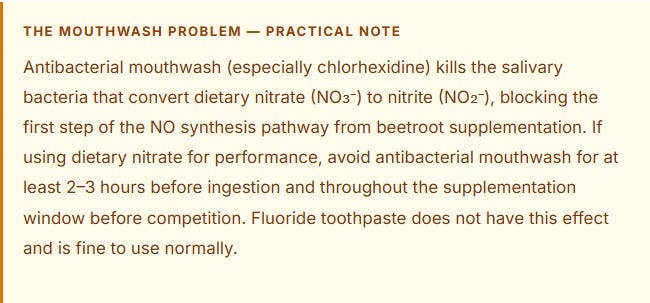
The oral hygiene problem is an underappreciated confound in the dietary nitrate literature. The salivary bacteria responsible for nitrate reduction are obligate inhabitants of the oral cavity. Antibacterial mouthwash — particularly chlorhexidine-containing formulations — kills these bacteria and substantially blunts the nitrate-to-nitrite conversion, eliminating much or all of the performance benefit. Several studies have documented this effect explicitly. Athletes who use antibacterial mouthwash routinely (for oral hygiene or breath-related reasons) may be receiving materially less benefit from dietary nitrate supplementation than the trial literature would predict, and should avoid mouthwash use in the hours surrounding nitrate ingestion if using beetroot strategically.
Safety, Interactions, and Contraindications
Citrulline and dietary nitrate are among the better-tolerated ergogenic compounds in the literature. Gastrointestinal side effects at the doses described are mild and uncommon. The blood-pressure-lowering effect of NO enhancement is generally modest in normotensive athletes but requires attention in two contexts: athletes already taking antihypertensive medications (particularly phosphodiesterase inhibitors such as sildenafil, which amplify the cGMP pathway that NO activates — a combination that can cause significant hypotension), and athletes with pre-existing low blood pressure who may experience symptomatic hypotension in heat during a match if combining nitrate supplementation with significant sweat-related volume depletion.
The beetroot juice discoloration effect — producing red-colored urine and stool (beeturia) — is harmless but worth noting so athletes are not alarmed. It occurs in approximately 10–14% of the population and is related to a polymorphism in oxalic acid metabolism, not to the nitrate component.
Dietary nitrate from food sources (beetroot, leafy greens, celery, arugula) carries no meaningful health concern at the amounts relevant to sport supplementation. The historical concern about nitrate in cured meats was related to the combination of nitrate with secondary amines in preserved meat (forming potentially carcinogenic nitrosamines) — a mechanism that does not apply to vegetable-source nitrate in the context of sport supplementation.
What the Research Cannot Yet Tell Us
The citrulline and dietary nitrate literatures, while encouraging, have limitations that deserve acknowledgment. Most citrulline trials are conducted in untrained to moderately trained populations, where effect sizes are typically larger and more consistent than in highly trained athletes. The few studies conducted in elite athletes show smaller but still significant effects — consistent with a general principle in sport nutrition that the ergogenic ceiling decreases as training level increases and baseline physiology is already optimized.
Tennis-specific trials remain limited. Thompson’s 2017 work is the best available, but a single intermittent exercise study is not sufficient to generalize dosing, timing, and effect size to competitive match play across surface conditions, temperature ranges, and competitive levels. The field needs more ecological validity — longer protocols, actual match play conditions, and athlete populations representative of competitive tennis rather than laboratory cyclists.
The interaction between NO-based ergogenics and heat is an area of active research with particular relevance to outdoor tennis. The thermoregulatory demands of exercise in heat require increased skin blood flow (to facilitate heat dissipation), which competes directly with muscular blood flow during intense effort. NO-driven vasodilation should theoretically support both simultaneously — improving thermoregulation and exercise capacity — but the evidence base for this interaction in sport-specific protocols is still developing.
Conclusion
Nitric oxide sits at the intersection of exercise physiology, vascular biology, and nutritional biochemistry in a way that few molecules do. Its role in regulating blood flow to working muscle, reducing the oxygen cost of work, and supporting recovery between high-intensity efforts makes it directly relevant to tennis performance — particularly across the longer time scales of extended match play and high-density training periods.
The supplementation strategy that best exploits this biology is citrulline malate — not L-arginine, despite arginine being the direct substrate for NO synthesis — because the pharmacokinetics of oral supplementation favor citrulline’s bypass of hepatic first-pass catabolism. The dietary nitrate pathway via beetroot juice offers a complementary and in some domains better-supported route to elevated plasma nitrite and increased NO bioavailability, with timing and oral hygiene considerations that differ from the citrulline approach.
Neither compound competes with creatine or caffeine as the most consistently evidence-backed ergogenic aid in tennis physiology. But both sit in the second tier of evidence — better supported than most of what fills supplement marketing — and have specific applications in the long, hot, intermittent demands of competitive match play that warrant serious consideration by coaches and athletes making evidence-based choices about performance nutrition.
The next article in this track turns to vascular adaptation from training — how regular exercise remodels the endothelium, raises eNOS expression, and produces the capillary density increases that underpin long-term aerobic development. The supplementation story is the acute picture; the training adaptation story is what sustained improvement in vascular performance actually looks like over months and years.