Of all the nutritional concepts that have entered athletic culture, protein has become the most discussed and the least understood. The recommendation to consume more of it is nearly universal; the mechanism behind it is almost entirely absent from the conversation. Athletes track protein grams the way they track caloric targets — as a number to hit, not as a biological process to understand. This matters because the mechanism is not incidental. It determines which source, at what dose, consumed at what frequency, produces the outcome. A number on a nutrition label says nothing about whether the mTORC1 signaling cascade will activate, whether the leucine threshold will be crossed, or whether the feeding window will overlap with a period of enhanced muscle sensitivity. This article covers the mechanism from the first amino acid to the last translated peptide.
What Protein Is
Proteins are chains of amino acids linked by peptide bonds. Twenty amino acids are used to build human proteins. Nine of these are essential — histidine, isoleucine, leucine, lysine, methionine, phenylalanine, threonine, tryptophan, and valine — meaning the body cannot synthesize them in adequate quantities and they must come from the diet. The remaining eleven are conditionally or unconditionally non-essential, synthesizable from other metabolic intermediates under normal conditions.
From a structural standpoint, dietary protein is not consumed as a building material that travels directly to muscle. It arrives as raw material — chains that must first be dismantled into their constituent amino acids, absorbed, transported to target tissues, and reassembled according to genetic instructions. The fate of those amino acids at every step depends on the body’s current metabolic state, the quantity consumed, the quality of the amino acid profile, and the timing relative to mechanical demand.
From Plate to Muscle — Digestion and Absorption
Proteolysis begins in the stomach, where hydrochloric acid denatures protein structure and pepsin begins cleaving peptide bonds. The resulting peptides enter the small intestine, where pancreatic proteases — trypsin, chymotrypsin, and elastase — continue the breakdown. Brush border peptidases at the intestinal wall reduce these to di- and tripeptides and free amino acids, which are absorbed via specific transporters into the intestinal epithelium and passed into portal circulation.
The liver receives this amino acid load first and extracts a portion for hepatic protein synthesis and gluconeogenesis. Critically, the branched-chain amino acids — leucine, isoleucine, and valine — largely bypass hepatic extraction and pass directly into systemic circulation, where they are taken up by peripheral tissues, including skeletal muscle. This is why branched-chain amino acids, and leucine in particular, occupy a distinct position in muscle protein metabolism: they arrive at the target tissue in higher concentrations than other amino acids following a meal, and they carry the primary anabolic signal.
The Signal: How the Muscle Knows to Build
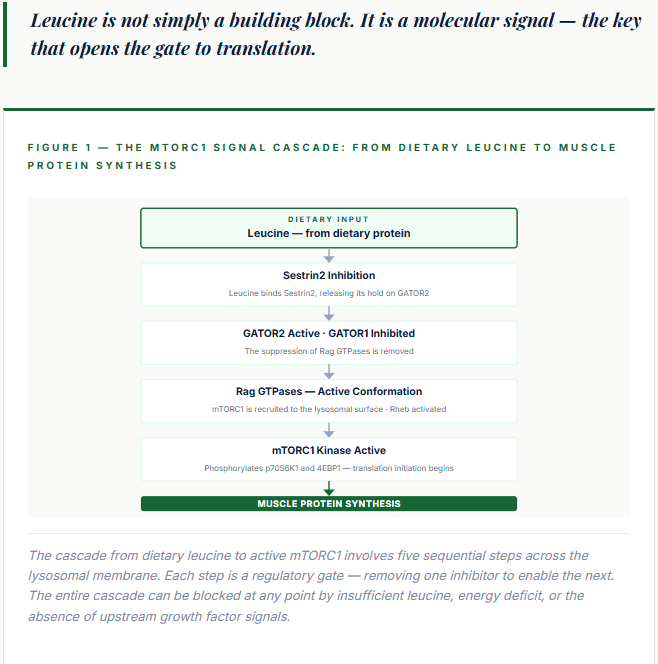
The machinery that produces muscle protein operates under the control of a serine/threonine kinase complex called mechanistic target of rapamycin complex 1 — mTORC1. When active, mTORC1 phosphorylates two downstream targets — ribosomal protein S6 kinase 1 (p70S6K1) and eukaryotic initiation factor 4E-binding protein 1 (4EBP1) — that together initiate the translation of messenger RNA into new structural protein. mTORC1 is the molecular switch for muscle protein synthesis at the cellular level. When it is on, ribosomes assemble amino acids into protein chains. When it is off, they do not.
mTORC1 receives input from multiple upstream signals — growth factors such as IGF-1 and insulin, mechanical loading from resistance training, and amino acid availability. The amino acid input is the one most directly governed by nutrition, and the specific amino acid that carries the primary activating signal is leucine.
The cascade operates as follows. Leucine concentrations are sensed in the lysosomal lumen by a protein called Sestrin2, which functions as a molecular gatekeeper. In the absence of adequate leucine, Sestrin2 binds to and inhibits GATOR2, a multiprotein complex that promotes mTORC1 activity. When leucine concentrations rise above threshold, leucine binds Sestrin2 and causes it to release GATOR2. GATOR2, now free, inhibits GATOR1 — which under normal circumstances suppresses a set of small GTPases called Rag proteins. With GATOR1 inhibited, the Rag GTPases shift to their active conformation and recruit mTORC1 to the lysosomal surface. There, mTORC1 encounters Rheb — a GTPase that, when active, directly stimulates the mTORC1 kinase. mTORC1 then phosphorylates p70S6K1 and 4EBP1, releasing the brakes on mRNA translation and initiating muscle protein synthesis.
The Leucine Threshold
The mTORC1 cascade described above is not linear. It has a threshold — a minimum leucine concentration below which the signal is insufficient to meaningfully activate mTORC1 and drive a measurable MPS response. Foundational work by Layman and colleagues established the concept of a dietary leucine threshold; subsequent work by Norton (yes that Norton) and Layman refined it for practical application in athletic populations.
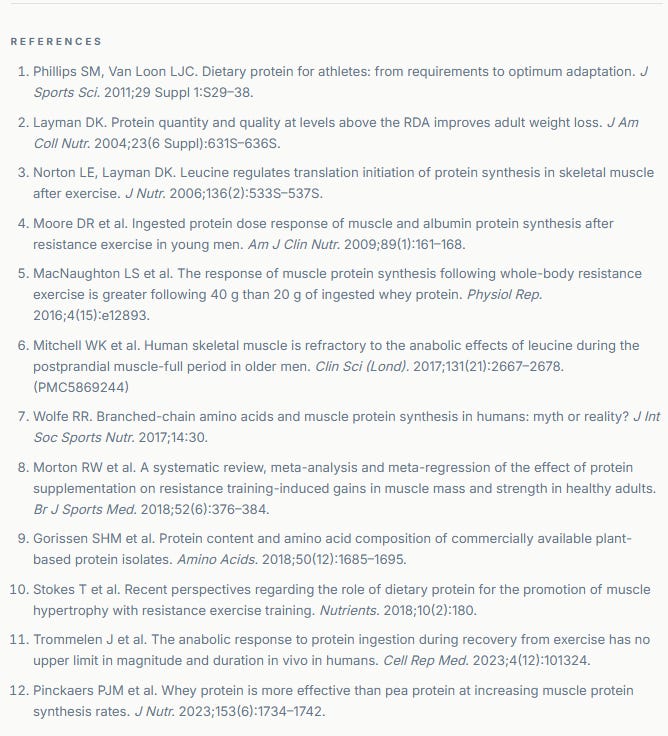
The threshold appears to sit at approximately 2.5 grams of leucine per meal to initiate a meaningful anabolic response, with approximately 3.0 grams — roughly 0.05 g/kg body weight — required to maximize it. Norton and Layman (2006) established this figure using animal models and in vitro work; subsequent human trials have been consistent with the range. In the Mitchell et al. (2017) study from the Nottingham lab, the EAA mix that produced a full MPS response contained 3.59 grams of leucine — placing the effective maximizing dose at approximately 3 to 3.5 grams, depending on the source and the individual. Below this threshold, a protein-containing meal may contribute to total daily amino acid availability but does not generate a robust mTORC1 signal. The Sestrin2 sensor simply does not disengage. The gate stays closed.
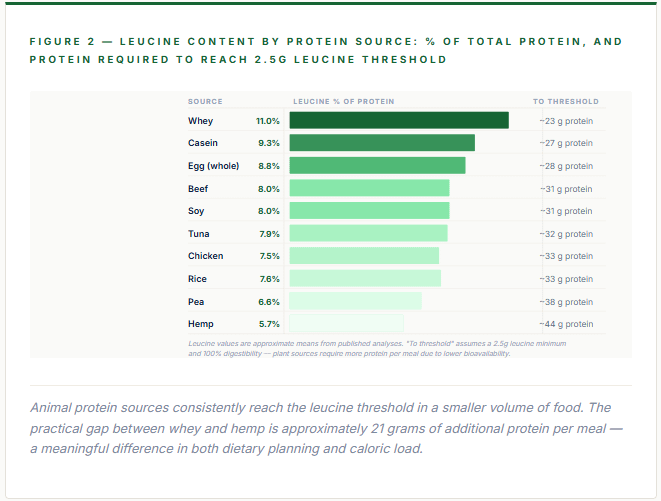
This has direct implications for food selection. A protein source’s leucine content — expressed as a percentage of its total protein — determines how much of that source is required to reach threshold at a given meal. Whey protein, at approximately 11% leucine by weight, delivers 2.5 grams of leucine in roughly 23 grams of total protein. The same leucine dose from a lower-leucine source may require 38–45 grams of total protein — and may still fall short if digestibility is limited.
The Muscle Full Effect
Muscle protein synthesis does not operate continuously. Following a meal that successfully crosses the leucine threshold and activates mTORC1, MPS elevates and then returns to baseline — even if circulating amino acid levels remain elevated. This refractory period, formally documented in human skeletal muscle by Mitchell, Atherton, and colleagues at the University of Nottingham, represents a ceiling on what any single protein feeding can accomplish, regardless of how much protein that meal contains.
The human timeline, established by Mitchell et al. (2017) using a 15-gram essential amino acid feed containing 3.59 grams of leucine, is as follows: MPS rises and remains elevated from approximately 90 to 180 minutes post-feeding, then returns to basal rates at approximately 180 minutes — a fed-state anabolic window of roughly three hours. An important dissociation: mTORC1 substrate phosphorylation (p70S6K1, 4EBP1) persisted toward peak levels at 3 to 4 hours post-feeding, even after MPS itself had returned to baseline. The signaling machinery remained primed while translational activity had already concluded. The authors identified eEF2 phosphorylation — a brake on mRNA elongation, downstream of mTORC1 — as a likely mechanism of that termination. It should be noted the Mitchell et al. study used older men (~70 years), a population with known anabolic resistance; the fundamental refractory mechanism is consistent with findings from younger cohorts, though the precise window may differ slightly.
The most direct demonstration of the refractory state came from within that same study: 3 grams of additional leucine administered at 90 minutes post-feeding — when MPS was still actively elevated — caused plasma leucine to spike an additional 770 percent above fasting levels. MPS did not extend. It returned to baseline at 180 minutes regardless. The muscle was completely unresponsive to the additional leucine stimulus. This is the central finding: during the muscle-full state, leucine is not the limiting factor. More leucine changes nothing.
The practical implication is significant: consuming 80 grams of protein in one meal does not produce twice the anabolic response of 40 grams. Once the threshold has been met and the MPS response is underway, additional amino acids are directed to other metabolic uses or oxidized. For meal spacing, the refractory data points toward approximately 3 to 3.5 hours between protein feedings to allow full clearance of the anabolic window before the muscle becomes responsive again. The muscle’s response has both a ceiling and a clock — and most athletes significantly underestimate both.
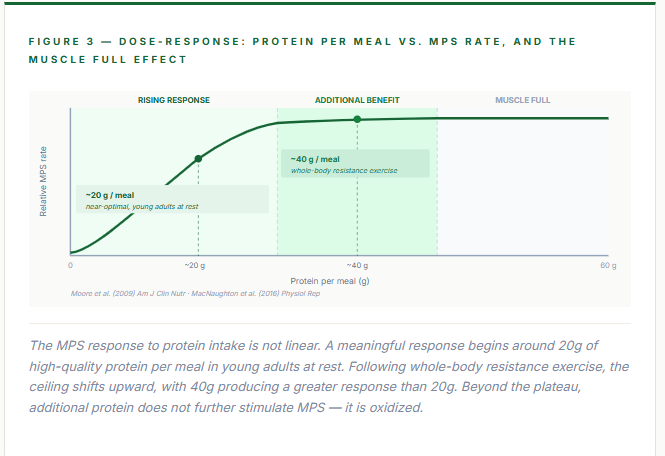
The muscle full effect, combined with the leucine threshold, argues for distributing protein intake across multiple meals rather than concentrating it. Research supports approximately 0.4 grams of protein per kilogram of body weight per meal, spaced roughly every 3–4 hours, as a framework for maximizing the number of discrete MPS peaks across the day. For a 75 kg athlete, that corresponds to approximately four meals of 30 grams of high-quality protein — each capable of triggering a full mTORC1 response, with adequate recovery time between them for the muscle full refractory period to clear. This is also a consideration for what purpose small meals and snacks may or may not serve.
Protein Quality
Not all protein sources carry the same signaling value. Quality in this context is determined by two factors: amino acid completeness — whether all essential amino acids are present in sufficient quantities — and digestibility, which determines the proportion of ingested protein that actually reaches systemic circulation as free amino acids available for muscle uptake.
The current gold-standard metric is the Digestible Indispensable Amino Acid Score (DIAAS), which measures the bioavailability of each essential amino acid relative to a reference pattern and caps the overall score at the most limiting amino acid. Animal proteins — whey, casein, egg, beef, chicken, and fish — consistently score well. Plant proteins typically score lower, due both to reduced digestibility and to amino acid profile gaps: legumes are generally low in methionine, grains in lysine. The consequence is not that plant-based protein is without value, but that achieving the same anabolic signal from plant sources requires either a higher total protein intake per meal, deliberate source combination, or supplementation with isolated forms that have been processed to improve bioavailability and leucine density.
So revisiting Figure 2 with this in mind, here is what it actually looks like:
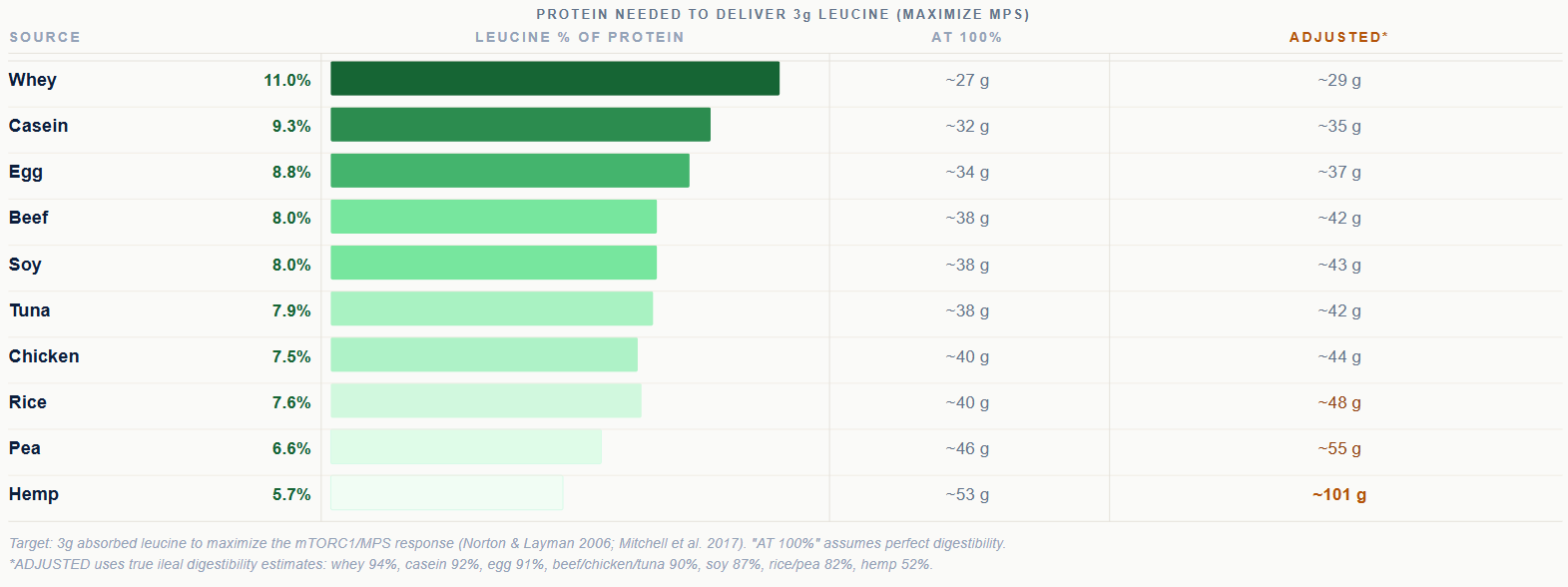
The data is neutral but the challenge is real. A vegan athlete eating whole foods faces a genuine leucine math problem that isn't opinion — it's arithmetic. The honest read is that isolates (soy, pea) solve most of the problem, higher total protein intake solves the rest, and combining sources addresses DIAAS gaps. That's not an attack on a vegan diet, it's useful information for vegan athletes. The people most likely to push back are the ones who don't want the challenge acknowledged at all
Timing — What the Evidence Actually Shows
The concept of an anabolic window — a narrow period following resistance training within which protein must be consumed or the anabolic opportunity is lost — has not held up well in controlled investigation. A frequently cited 2013 meta-analysis and subsequent literature reviews found that when total daily protein intake is equated, the timing effect within the first hour post-exercise is modest to negligible as a standalone variable. Total daily protein is the dominant determinant of muscle protein balance over time.
There is, however, a legitimate basis for consuming protein proximate to training — within a two-to-three hour window on either side. Mechanical loading increases muscle sensitivity to amino acids and enhances the mTORC1 response to a given leucine dose. This is not the same as a 30-minute hard cutoff. If pre-training nutrition was adequate and total daily protein targets are being met, the timing question is unlikely to determine outcomes. If pre-training nutrition was absent, the post-training meal becomes more time-sensitive. Context matters more than the window itself.
Athlete Dosing — What the Data Supports
The current Recommended Dietary Allowance for protein — 0.8 grams per kilogram of body weight per day — was calculated to prevent deficiency in sedentary adults. It was never designed as a performance target and is not appropriate as one for athletes in regular training.
A 2018 systematic review and meta-analysis by Morton and colleagues, drawing on 49 randomized controlled trials primarily from the Phillips laboratory, found that protein supplementation significantly augmented gains in lean mass and strength during resistance training. The analysis identified a plateau effect at approximately 1.62 grams per kilogram per day, beyond which additional protein did not produce additional hypertrophy in the study populations examined. This represents the best current estimate of the upper effective dose for hypertrophy-focused training in young adults.
Practical recommendations for athletic populations generally sit in the range of 1.6 to 2.2 grams per kilogram per day, with the higher end of the range supported for athletes under heavy training loads, those in caloric restriction, or those with elevated muscle damage from the training stimulus.
Special Circumstances
Caloric Deficit
During periods of energy restriction, muscle protein balance shifts negative — catabolism accelerates as the body mobilizes amino acids for gluconeogenesis and direct energy production. Research, including work by Helms, Phillips, and colleagues, consistently shows that higher protein intakes during caloric restriction — toward 2.2 to 2.4 grams per kilogram per day in severe restriction — meaningfully attenuate lean mass loss compared to lower intakes, even when total calories are equated. The mechanism is direct: maintaining amino acid availability in circulation reduces the degree to which the body must catabolize existing muscle protein to meet metabolic demands.
Aging Athletes
Skeletal muscle becomes progressively resistant to the anabolic effects of protein with age — a phenomenon termed anabolic resistance. The mTORC1 signaling response to a given leucine dose is blunted in older muscle, and the magnitude and duration of the post-exercise MPS peak are attenuated. A consistent body of meta-analyses, including recent literature confirming benefits in sarcopenic populations, shows that protein supplementation combined with resistance training significantly improves muscle mass and functional outcomes in older adults, with whey protein demonstrating the strongest effect across protein types.
The practical implication for older athletes is that per-meal dosing targets shift upward. Research suggests that approximately 35 to 40 grams of high-quality protein per meal may be required in older adults to generate the same mTORC1 response that 20 to 25 grams produces in younger individuals — a direct consequence of the blunted Sestrin2-GATOR2 sensitivity at the lysosomal sensor level. For aging athletes who are serious about maintaining performance and body composition, this is among the most practically significant findings in the protein literature.
What the Data Does Not Support
The notion that protein consumed beyond effective daily amounts converts efficiently into additional muscle is not supported. The body has no protein storage system equivalent to glycogen or adipose tissue. Amino acids that exceed what can be used for protein synthesis are deaminated — the nitrogen is excreted as urea, and the carbon skeleton is either oxidized for energy or converted to fat under conditions of surplus. The dose-response ceiling is real, the evidence for it is robust, and consuming substantially beyond 2.2 grams per kilogram per day is unlikely to produce additional hypertrophy benefit in healthy training adults. Beyond that range, additional protein is not harmful in healthy individuals — it is simply not additive for the purpose most athletes are optimizing for.
Safety
The persistent concern that high protein intake damages kidney function in healthy individuals is not supported by controlled evidence. Multiple systematic reviews and longitudinal studies on athletic populations consuming well above 2 grams per kilogram per day show no adverse effect on glomerular filtration rate, serum creatinine (adjusted for the expected rise from creatine metabolism), or other markers of renal function in people without pre-existing kidney disease. The confusion arises in part from the clinical management of diagnosed chronic kidney disease, where protein restriction is sometimes indicated as a disease management strategy — a therapeutic context with no bearing on healthy athletes.