


The last piece closed with the LTAD frame stated at its most compressed: athletic development is a long-term process measured in years and decades, and training emphasis at any stage should be set by the athlete’s developmental age, not current results and certainly not their parents’ ambitions. That piece also made the case for why we don’t peak for weekend tournaments, and for why the ITF’s own junior structure — no competition under 13, a maximum of five events from 13–14, a best-five-or-six ranking system after that — already tells you how few tournaments in a season are actually meant to be peak events.
What that piece didn’t do is unpack what “developmental age” actually means before an athlete is anywhere near a competitive calendar worth worrying about. That’s this piece. Long before frequency and scheduling are live questions, there’s a large and frequently rushed body of foundational work in coordination, movement, and motor learning that determines whether everything built afterward has anywhere solid to sit.
The LTAD Stages, Briefly
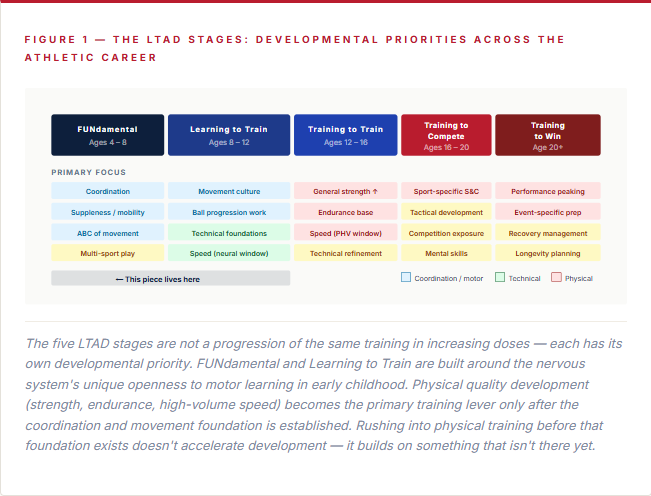
Long-Term Athletic Development (LTAD) was built originally by Istvan Balyi out of Eastern Bloc sport science — closely aligning with my own training, coaching experience and education — and it’s since been adapted and validated across federations globally, including the Belgian and Dutch frameworks I’ve studied closely. Its stages run roughly: FUNdamental, Learning to Train, Training to Train, Training to Compete, Training to Win. Each has its own developmental priorities, and none of them is a scaled-down version of the one after it.
The early stages — FUNdamental and Learning to Train — are where this piece lives. This is where a lot of American junior development goes wrong: not in the physical training years, but in skipping straight past this stage to get there faster.
Where It Actually Starts: Coordination and Suppleness
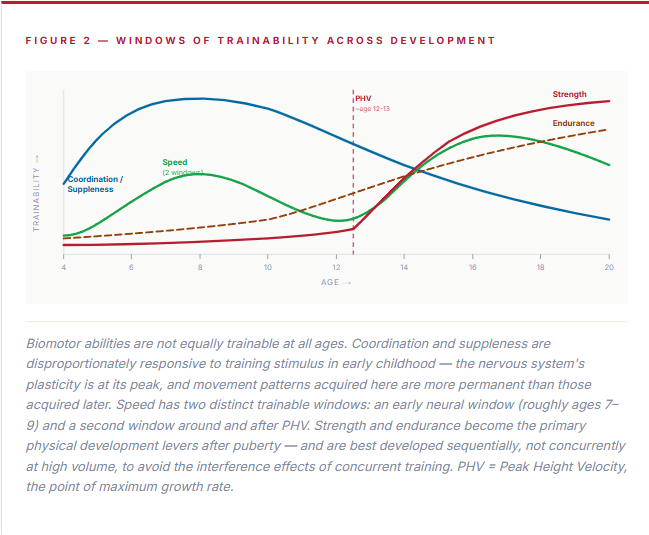
The two biomotor abilities that come first, developmentally, are coordination and suppleness (mobility and flexibility) — not strength, not speed, not endurance. This isn’t a stylistic preference; it reflects when each quality is actually trainable. The nervous system’s capacity for motor learning is disproportionately open in these early years — a young athlete acquires new movement patterns faster and more permanently than at almost any later point in development.
Structured strength and power work, by contrast, has a limited return and a disproportionate injury risk before the athlete has the coordinative base to control the loads and movements involved. Training strength before coordination is available to express it, is training on a foundation that isn’t there yet.
This is why the earliest years of development should look far more like general athletic education than tennis practice. And it’s why rushing an athlete into tennis-specific technical repetition before this foundation exists is one of the most common — and most expensive — mistakes we see.
Movement Culture: Complete Player Development
This is the part that gets skipped most often, and it’s the part I’d call movement culture — the deliberate weaving of general movement patterns into a young athlete’s development before, and alongside, stroke-specific technical work.
The library of work at this stage is genuinely large — easily hundreds of different exercises, games, and activities across a full development year. Here are three examples that illustrate the underlying logic, but they are not a summary of the work:
Directional change and first-step patterns. Before an athlete is drilled on footwork “for tennis,” they need the general coordinative vocabulary for changing direction efficiently and reacting explosively off a stationary position. This is trained as movement — through games and general athletic work — long before it’s trained as a split-step or a recovery pattern.
Overhand throwing as the foundation for the serve. The serve is, mechanically, quite similar to throwing motion: trunk rotation, external rotation and rapid internal rotation of the shoulder, a kinetic chain sequenced from the ground up. That pattern is built far more efficiently through general throwing — balls, objects, games — than by drilling serve technique on an athlete who has never developed a competent overhand throw. Teach the throw. The serve technique sits on top of it.
Balance and weight transfer through jumping and landing. A large portion of early movement work involves jumping exercises — in and out of rings or hoops, in different directions, initially stationary and then in continuous flow. The progression is not arbitrary. A child doesn't need to understand the vertical projection of their center of mass within their base of support (static balance). What they learn to feel is this: the weight shifting forward into a knee bend, the jump, repositioning the feet ahead of the body to absorb the landing, and then transferring weight forward over the feet again to generate the next movement. Static balance first, dynamic balance as it develops. What this builds, well before a tennis racquet is involved, is the physical vocabulary of reactive movement. Tennis is a reactive game — you need to know how to move, how to stop (absorb momentum without losing balance), how to use that momentum aggressively in the next direction or a stroke, and recover. An athlete who hasn't developed this foundation tends to stand tall, weight on the heels, knees naturally straight rather than loaded — what you might call an unathletic stance. They are slow to initiate, clunky in direction change, and slow in anticipation of the next movement. On court, that translates directly into poor setup: wrong contact point, too high or too low, too late or too early, too close or too far from the body. The ball dictates rather than the athlete. When a coach inherits that athlete later in development, they face the much harder job of trying to rebuild what should have been established years earlier — now competing against ingrained habits, a less plastic nervous system, and a competitive calendar that leaves no room for the work.
Those three barely scratch the surface of what this work actually looks like in practice. The equipment alone tells the story: tennis balls of every compression, crazy balls, beach balls, spiky balls, mini balls — each one producing different bounce behavior, different spatial demands, different reaction requirements. Hurdles, agility ladders, domes, and cones. Racquets and sticks used as coordination and proprioception tools, not as stroke-production equipment. Spider crawls, bear crawls, crab walks, lateral shuffle patterns, reactive games built around reading and responding rather than executing predetermined movements. Hundreds of different activities, often overlapping, constantly rotated to prevent pattern habituation and keep the nervous system in the learning state that early childhood uniquely enables. The specific exercises matter less than the principle behind all of them: varied, game-based where possible, aimed at the underlying qualities — balance, spatial awareness, timing, proprioception, force production and absorption from novel positions — that the stroke mechanics will later be built on top of.
Within that library, there is an important distinction worth making. Some of the work is general and broadly applicable — hurdle patterns, lateral shuffle games like the iggy shuffle, reactive ball-drop games, crawl sequences — activities that serve the development of any athlete at this stage, regardless of their individual profile. But a large portion of what actually happens in a session is targeted and individually prescribed. Two athletes the same age at the same stage can present with completely different limiting factors: one struggles to produce a functional overhand throw — the pattern simply isn’t there yet — and so the prescription leans heavily on throwing games and progressions until that motor pattern is established. Another may have a perfectly competent throw but struggles to read ball trajectory, to predict where the ball is going to be rather than where it is — and so the work shifts toward tracking games, irregular-bounce balls, and exercises that force the athlete to anticipate rather than react late. There is no standard program that applies uniformly. The stage sets the developmental priority. The individual assessment tells you where to actually put the work.

The goal is for each stroke to be built on top of competent movement rather than around the absence of it. When that sequencing is respected, technical development is faster, more stable, and produces fewer compensations that require correcting later.
Ball Progression Is a Coordinative Tool, Not Just a Technical One
The red, orange, and green dot ball progression exists for exactly this reason, and it’s worth being precise about why. Each stage reduces ball speed, bounce height, and compression, and pairs that with a smaller court — calibrating the physical and coordinative demand of the game to what the athlete can actually move to and set up for. It is not a simplified version of tennis for beginners to graduate out of quickly. It’s a sequencing tool, and the sequencing is the whole point.
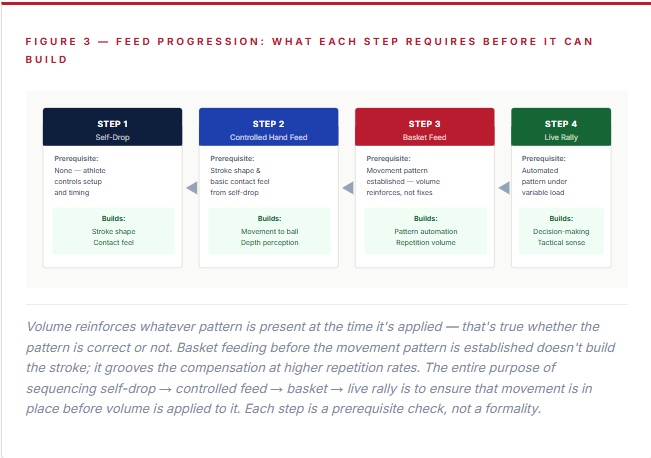
This is where I want to be specific about something we don’t do: we do not progress from a self-drop to basket feeding before the athlete has learned to move and set up correctly on court. Basket feeding produces more repetitions per minute, and more repetitions look like progress. But if an athlete can’t yet move their feet to the ball, read a bounce, and set up their base before contact, a higher-volume feed doesn’t build the stroke — it grooves a compensation (ie bad technique). Reaching instead of moving. Arm-only swings instead of a full kinetic chain. Poor spacing that gets corrected, if it ever does, years later at real cost.
When the Physical Qualities Take Over
This coordination-and-movement foundation is largely established before puberty. What changes it is peak height velocity (PHV) — the point of maximum growth rate — followed by peak weight velocity (PWV), the corresponding surge in mass. Around and after this window, the developmental priority shifts toward general strength, endurance, and speed.
One point worth being precise about here: these qualities are developed separately, not simultaneously at high volume, because of what’s known as the concurrent training effect — the physiological interference that occurs when high-volume strength and power work and high-volume endurance work are trained hard at the same time. The adaptations partially compete for the same cellular signaling pathways, and the athlete ends up compromising both rather than maximizing either.
This is a real constraint for a mature athlete with a large recovery capacity. It’s a far bigger one for a developing athlete whose recovery capacity hasn’t caught up yet. Sequencing strength, endurance, and speed development deliberately — rather than maximizing all three concurrently because a competition calendar demands it — is one of the central jobs of program design in this stage.

A Framework, Not a Formula
Nothing in this piece is meant to be lifted and applied directly — not by a coach, and not by a parent. That distinction matters, so it’s worth being explicit about it.
For coaches, the intent is to offer a reference point and a way of thinking. If your current model differs from what’s described here, this is a framework to test your own approach against — not a program to replicate. The translation from conceptual understanding to applied program design requires your knowledge of your athletes, your setting, your resources, and years of observation that no article can substitute. What this can do is sharpen the reasoning behind decisions you’re already making, or surface assumptions worth revisiting. The due diligence, the learning, and the application are still yours to do.
For parents, the intent is different and arguably more valuable: this is a lens for assessment, not a manual for action. Understanding the LTAD model well enough to evaluate whether a program is actually doing what it claims — whether the stage-appropriate emphasis is there, whether the sequencing makes sense, whether the competitive structure reflects genuine developmental thinking or just the appearance of it — is genuinely useful. You don’t need a coaching license to ask better questions or to recognize when something doesn’t add up. What you do need to stop well short of is attempting to replicate this work at home, constructing training plans, or treating your understanding of the framework as a substitute for professional expertise. The analogy I keep coming back to is residential construction: knowing how a load-bearing wall works helps you evaluate a contractor and catch a problem early. It does not qualify you to act as your own structural engineer. Coaching athletic development is not structurally different, and the consequences of getting it wrong are measured in a child’s physical health, confidence, and long-term relationship with the sport.
One more thing, stated plainly: this framework has no relationship to tournament points, UTR ratings, or peak performance at twelve years old. These are not outputs the model is optimizing for, and the developmental time and sequencing it protects cannot be recovered once it’s been spent chasing those proxies instead. The athletic potential is real. The window is finite. The bet on being the outlier — the one child who skips the foundation and still reaches their ceiling — is not a bet worth placing at a kid’s expense.
What This Sets Up
Everything in this piece — the coordination-first sequencing, movement culture, the ball and feed progressions, and the PHV/PWV-anchored shift toward physical quality development — happens on a timeline that has nothing to do with a tournament calendar. It’s biologically ordered, individually variable, and it does not rush.
We’ve already made the case for why we don’t peak for weekend tournaments and why the ITF’s own structure treats most junior events as development, not competition. What we haven’t done yet is connect that argument to the stages laid out here — why the density and shape of competitive exposure should look completely different in FUNdamental and Learning to Train than it does once an athlete reaches Training to Compete, and why collapsing that difference is a large part of how the adult tour model ends up misapplied to a ten-year-old. That’s Part 2.
From the Court is a series on the science and methodology behind elite tennis development. · No. 01: Three Training Principles That Always Matter · No. 02: Training vs. Exercise: The Five Variables That Make the Difference · No. 03: Why “Tennis Wrist” Isn’t About How Much You Play · No. 04: Why We Design Programs · No. 05: The LTAD Model, Part 1: Building the Athlete Before You Build the Player · No. 06: The LTAD Model, Part 2: Why Competitive Density Has to Match the Stage — coming August 4 · No. 07: There Is No “Optimal” Contact Point — There’s Yours — coming soon