art 1 made the case that the early stages of athletic development are not a scaled-down version of what comes later. The FUNdamental and Learning to Train windows run on a different developmental logic — coordination first, movement culture before stroke mechanics, physical quality development sequenced by biological readiness rather than competitive schedule. None of that work is complete before a junior athlete begins playing tournaments. But the question this piece takes on is what happens when the competitive calendar becomes the organizing principle of development — when tournament volume drives the training plan rather than the other way around. The research is consistent. The governing body structures reflect it. Coaches who have worked long enough at this level have watched the pattern repeat enough times that it stopped being surprising. What excessive competitive density does to an athlete’s development, and when competition is actually useful as a developmental tool rather than a tax on training time, is what follows.
Competitive Density: The Term, and What It Looks Like When Wrong
Competitive density means how much tournament play an athlete is doing relative to their total training, at a given stage of development. It isn’t just the number of events — it’s the ratio, the intensity of preparation around them, and whether the competition is serving development or substituting for it.
One thing that’s easy to miss at the junior level is how much noise there is in competitive outcomes. Performance scatter among junior players of comparable ability is enormous — driven not primarily by skill gaps but by mental-state variance, daily readiness, fatigue, and the emotional instability that is normal and expected at this stage of development. Two junior athletes of equivalent level can each beat the other 6-2, 6-3 a weekend apart. That’s not unusual. It is a routine product of the variance inherent to junior competition, and it means that single-match and single-tournament results are largely noise. They don’t tell you which athlete is developing better. They tell you who had a better day — or emotional moment — than the other. Competitive density narrows sensibly as athletes mature and mental stability develops. Holding it flat from age 9 through 17 reflects a misunderstanding of what competition is actually measuring at each stage.
What shows up consistently in athletes who arrive with excessive tournament histories is not a sharper competitive edge — it’s a recognizable cluster of deficits. Physical underdevelopment relative to their chronological age. Poor coordination. Weak general endurance and work capacity. Injury-proneness and poor heat and cold tolerance. And, most telling: an inability to follow through on any task that doesn’t optimize for win probability in the short term. The athlete conditioned to prioritize results above learning has been trained, functionally, to resist learning. Learning requires a period of temporary incompetence — the interval in which a new pattern isn’t yet reliable, where it might cost a set or match point. When winning is the frame, temporary incompetence becomes intolerable. The baseline player who refuses to develop a net game or an attacking approach isn’t being stubborn. They are responding rationally to the incentive structure they have been operating inside since they were eight years old. That structure was built wrong.
How the Adult Model Gets Misapplied to Kids
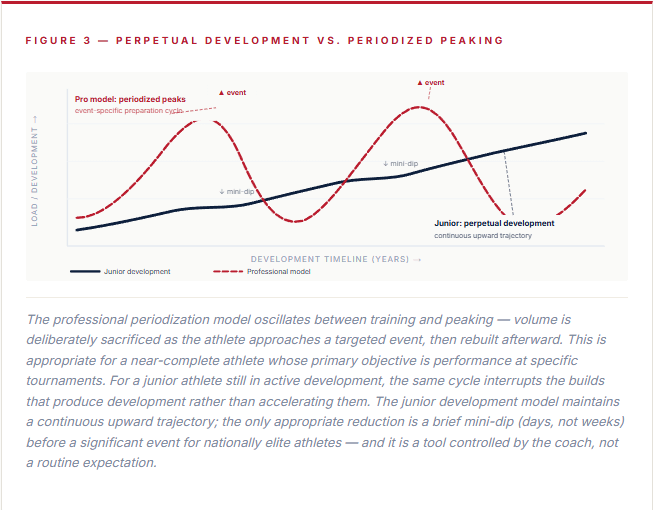
The professional model is built around periodized peaking: a structured cycle of volume, intensity, and competitive specificity that converges toward maximum readiness at targeted events. A professional player does not maintain full development volume through their competitive season — they manage load carefully, accumulate match-specific fitness through competition, and arrive at marquee events with the precise readiness those events require. This is appropriate, sophisticated, and correct for a near-fully developed athlete whose training agenda is primarily refinement and maintenance of a largely complete skill set.
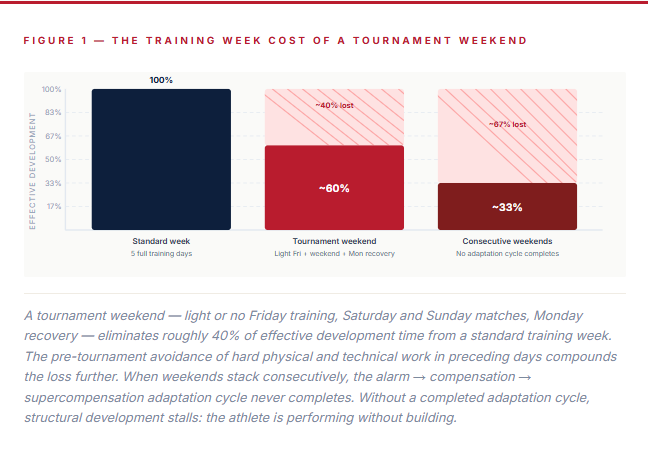
It has no place in junior development, for reasons that go beyond preference. A junior athlete is not refining a complete set — they are building an incomplete one, and the list of what remains unbuilt at 13 is enormous: stroke repertoire, movement patterns, reading the ball on the rise to take away time or on the fall to enhance topspin, approach play, construction patterns, game styles, tactical decision trees. That work happens through training volume — repetitions that take a new skill from introduced to automated. When competitive preparation cuts that volume, it doesn’t taper a developed athlete toward a performance peak. It interrupts an athlete mid-build. The adaptation cycle requires a complete sequence: training stimulus → fatigue → recovery → supercompensation. Tournament weekends interrupt that cycle before it completes. The result is compromised or absent structural adaptation — performance without development. This is precisely why the ITF caps countable results to the best five or six events rather than rewarding every-weekend play: the structure reflects the understanding that development requires training time, and that rating inflation through constant competition produces neither one.
There is also an infrastructure problem that rarely gets acknowledged openly. A professional tennis player is surrounded by a full support team — coach, fitness trainer, physiotherapist, and often a team doctor — monitoring sleep, hydration, stress load, and physical readiness in real time. That team will withdraw the player from a match or a tournament at the first credible red flag: a shoulder concern, a back tightness, an unusual fatigue pattern (except perhaps Rafa). A junior athlete has none of that. What they have is their coach and their parents, a relationship that frequently breaks down under competitive pressure. Compounding this: autoregulation — the capacity for self-awareness of physical limits, the ability to know when enough is enough — is a skill that develops with maturity. Early-stage athletes are systematically poor at it. Which is exactly the stage when external load management provided by a well-aligned coach and parent matters most. When that alignment breaks down, the athlete absorbs the cost alone.
What Actually Gets Sacrificed
The physical cost is the most quantifiable. A typical tournament weekend — light or no Friday, match play Saturday and Sunday, Monday as recovery — consumes roughly 40% of a five-day training week. Add the pre-tournament mindset: the avoidance of hard running, serious gym work, and technically demanding court sessions in the days before, and the cumulative loss is larger still. This isn’t just volume lost — it is developmental time lost. A session of hard movement work at age 11 produces a specific adaptation. A session of match play at age 11 produces a different one. They are not interchangeable, and counting them as equivalent is a category error with compounding consequences.
The technical cost is subtler but equally real. Tournament play without a coach-defined developmental goal — a specific pattern to execute, a tactical task to carry through the match regardless of outcome — is reinforcement of whatever the athlete brought into the match. Good habits get reinforced. Compensations get reinforced too, at competitive intensity and under emotional stakes, which makes them more durable and harder to unwind. Parents cannot set those developmental goals unless they are also the athlete’s coach. This is not a criticism — it is a structural fact. The goals require diagnostic expertise, program knowledge, and ongoing assessment that the coach holds and the parent doesn’t. A tournament without a coach-defined task is a tournament with no developmental accountability.
The psychological cost is the most consequential, and the hardest to reverse. Parents naturally emphasize outcomes. Young athletes, emotionally immature and deeply oriented toward parental approval, amplify parental disappointment far beyond what an adult would. A parent’s quiet frustration at a loss can register to a 9-year-old as comprehensive failure — and the behavioral response is to do whatever produces the lowest risk of that disappointment again: play what works, compete through familiar patterns, resist anything new. This pattern instills winning-over-learning at exactly the developmental window when learning should be the entire point. Even the best players in the world — 20 Grand Slam titles and counting — continue to refine and learn throughout their careers. Junior athletes have orders of magnitude more to learn than a top-10 professional, not less. The urgency of learning should be highest at the earliest stages, not the reverse.

Stage by Stage: What Competition Should Actually Look Like
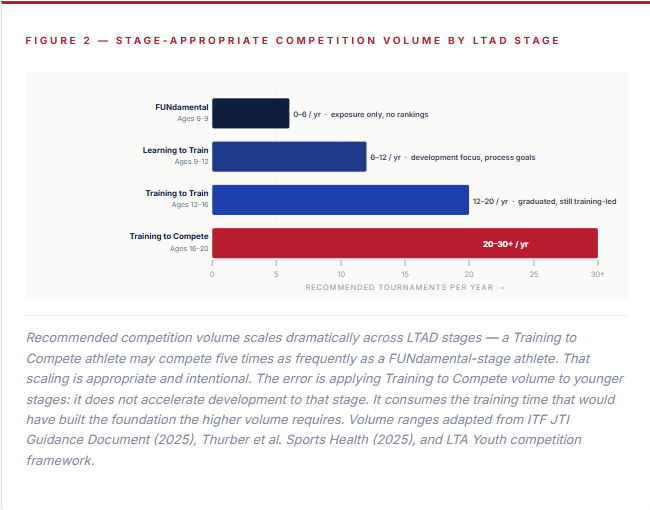
The ITF has no competitive pathway for players under 13. The LTA has no ranking system for players under 10. That is not an oversight — two of the world’s most thoroughly developed tennis organizations chose not to build one, and the reasoning is deliberate. What they built instead reflects the actual developmental function of competition at these ages. The ITF’s Tennis10s and Play and Stay framework gives young players their first experience of the game on modified courts with slower balls — a format calibrated to what the body and nervous system can actually access at this age, not a compressed version of adult tennis. The LTA’s Youth Matchplay for 8U and 9U: tie-breaks to 10 points, two-hour sessions, ability-matched draws. No sets. No rankings. The structure says everything: this is an introduction, not a test.
The research gives the same answer with numbers. A 2025 systematic review in Sports Health (Thurber et al.) recommends a ceiling of six tournaments per year for U10 players and sets the minimum age for regular tournament play at 12. It frames multi-sport participation not as an optional supplement but as the baseline expectation for healthy development. A 2022 meta-analysis of nearly 10,000 athletes across multiple sports (Güllich et al.) found that world-class adult athletes had more multi-sport exposure in childhood, less time in their primary sport, and later specialization than near-elite athletes — not by a small margin, but substantially. The athletes who specialized earliest were not the ones who reached the top. The ones who did had spent more of their early years building the broader athletic foundation first.
What healthy competition looks like at ages 6–9 is low-stakes, infrequent, ability-matched, process-oriented, and — above everything else — anchored to whether the child wants to come back next week. That is the only performance metric that matters at this stage. A child who leaves a competition excited about their game is succeeding developmentally. A child who leaves anxious about disappointing a parent is learning something different, and that lesson compounds. What unhealthy looks like is the mirror: win emphasis, parental outcome reactions, adult tactical frameworks imposed on athletes who lack the cognitive and physical prerequisites to execute them. A 7-year-old cannot reliably produce an attacking approach sequence — not because they haven’t been coached on it, but because the perceptual and motor systems required for that chain of decisions are not yet in place. This applies not just to biologically or chronologically young athletes, but also to those of young training age. Imposing the demand is not developmental pressure. It is developmental mismatch, and it teaches the wrong lesson about what the game is for.
When competition legitimately becomes a training tool — rather than a test applied to an incomplete system — is not a fixed age. It is the intersection of three variables: chronological age (where the player is on the calendar), training age (how many years of structured, sequential development they carry), and physiological age (where they are relative to biological maturation). A player who is 13 chronologically but carries seven years of structured training and is physiologically post-PHV is in a completely different position than a player who is 13 chronologically, two years into tennis, and pre-PHV. Treating them identically because they share a birth year is the category error the LTAD model was designed to prevent. The ITF’s floor of 13 for international competition and the LTA’s graduated format both reflect the same logic: build the capacity before you test it systematically. The capacity determines the timeline, not the calendar.
UTR: A Metric That Answers the Wrong Question
UTR has exactly one legitimate application: it tells a college coach, at the moment of active recruiting, what level a player is competing at right now. A coach with a roster spot and a scholarship needs a first approximation of whether a 17-year-old fits their lineup. UTR provides that. In that window, for that purpose, it is a functional tool.
For everyone else, at every other stage, it is answering a question no one should be asking. Worrying about a 12-year-old’s UTR is structurally identical to someone who has never trained seriously fixating on their bench press number — without actually doing any training. The number moves because you do the work. The only thing that has ever improved a UTR score is better tennis: better movement, sharper decision-making, stronger mechanics, a wider tactical range — developed through structured, well-sequenced work over years. Whether the outcome at 18 is an 11 or a 13 UTR is not determined by how closely you monitor the number at 12. It is determined entirely by the quality of work committed between now and then. Attention to the destination instead of the path does not change where you end up. It only diverts resources from what actually gets you there.
There is a second problem: UTR is a snapshot, not a forecast. It shows where a player is against the competition they have played, at their current stage, on that date. It says nothing about trajectory. A player with a 9 UTR at 13 who carries a full athletic foundation, a developing serve, and a coach who understands long-term sequencing may be a 14 UTR at 18. A player with a 10 UTR at 13 who has been specialized since age 8, plays 30 tournaments a year, and has limited movement capacity may plateau or regress. The number does not distinguish between them — it was never designed to. Competition density distorts the snapshot further: higher match volume can produce short-term rating movement that reflects exposure rather than development, at direct cost to the training hours that build sustainable improvement. Players from countries with little youth tournament culture often arrive with no UTR at all, then climb extremely rapidly once they begin competing — because the underlying game was already built. The metric reflects competitive exposure, not development. Treating it as a proxy for one when it only measures the other is how resources get misallocated for years.
What the Training Calendar Actually Looks Like
The most useful operating principle I have arrived at — for communicating with parents, structuring programs, and thinking about competitive planning — is a simple one: perpetual development, no peak until ready to compete internationally. That is not a poetic statement. It is a working philosophy with a specific practical implication: the default for a junior athlete is always to be building, never to be managed like a professional preparing for their marquee event. Development is the training result — not a phase between competitions.
The one exception I make is narrow. For athletes who are genuinely elite competitors within their national age group — not elite in spirit and ambition, but objectively top-ranked nationally — a brief volume reduction before a significant national event is reasonable. A few days to a week, not the multi-week competitive optimization a professional would employ for a Grand Slam. The critical point is that this is a tool the coach controls, not an expectation the parent manages. If parents come to expect regular peaks, they will start requesting them when they are not warranted — and the pressure to comply with parental expectations in junior tennis is already among the primary drivers of poor coaching decisions. It is better to operate from the baseline assumption of perpetual development, use a mini-peak when genuinely appropriate, and never create the expectation that peaks are a standard part of the junior calendar.
On ratios and benchmarks: individual differences in junior athletes make universal prescription a simplification that tends to mislead more than it guides. Different athletes present different physical profiles, different learning curves, different relationships with competition and failure. What works excellently for one athlete may suppress another. That said, the IOC’s consensus position on youth athletic development, LTA and ITF frameworks, and the Eastern European development systems that have historically produced technically and physically complete players all converge on one consistent point: physical development is not supplemental to tennis training for young athletes. It is a central part of it. A meaningful portion of total training time at younger ages — commonly referenced in the range of 40% or more — should be dedicated to off-court physical development: movement quality, strength and power foundations, speed, suppleness, general coordination. The USTA has historically been weak on this emphasis. Looking to the LTA, ITF, IOC, or Eastern bloc development frameworks gives a more complete picture of what physically rigorous early development should look like in practice.
The warning signs in a program that is not doing this are not subtle. Excessive imitation of professional game styles applied to athletes who lack the physical and cognitive prerequisites to execute them. Heavy competition volume with thin or absent off-court physical training. A 10-year-old playing 15 tournaments a year while spending an hour a week on anything physical. These are not indicators of a program pushing for excellence. They are indicators of a program harvesting short-term results from a developing asset without reinvesting in it — and the asset depreciates. The bill comes due later, usually as a plateau, an injury, or a player who peaked at 14 and spent the following years trying to understand why progress stopped.
The last point applies to coaches as much as programs, and it is the most important one. The goal of junior development is not to produce greatness. Greatness is rare, genuinely talent-dependent, and not something a program or a coach creates — it is something a program and a coach either support well or obstruct. The goal is to make the best possible version of each athlete who commits their development to your care, whatever that ceiling turns out to be. Every athlete can improve across every metric: coordination, strength, speed, suppleness, technical competence, tactical range, competitive resilience. Those gains are available regardless of talent ceiling, and they are worth pursuing seriously for every athlete in the program, not just the ones who might turn professional.
That requires something from coaches: not just competence, but the ongoing commitment to earn it — doing the research, accumulating the observational hours, pursuing the formal education and credentials that build the expertise parents are trusting you with. I pursued a graduate degree, multiple licenses, and certifications — and continue that work — not out of social obligation but out of professional integrity. The families who bring their children to me are placing genuine trust in my expertise. The cost of getting it wrong is their child’s time, physical health, and long-term relationship with the sport. That is an appropriate weight to feel, and it should motivate every professional in this field to be more informed, more accurate, and more honest than the environment currently demands of them. Everyone should do their best. In this profession, the stakes are high enough that best should mean something.