Ask five coaches where to hit the ball and you’ll get five confident answers. Top of the bounce. On the rise. On the fall. Whatever’s comfortable. Whatever the pros do. Each answer is delivered like a law of physics, and each one is wrong for at least half the players it’s given to.
The truth is less satisfying and more useful: there is no universal optimal contact point. There is an optimal contact point for you, and it’s set by the intersection of four things — grip, stroke mechanics, anthropometrics, and playstyle. On top of that fixed, player-specific default sits a situational layer, where you deliberately move earlier or later in the bounce based on what the point is asking of you. Two different decisions, two different timeframes, constantly conflated into one bad piece of advice.
Why “Top of the Bounce” Isn’t an Answer
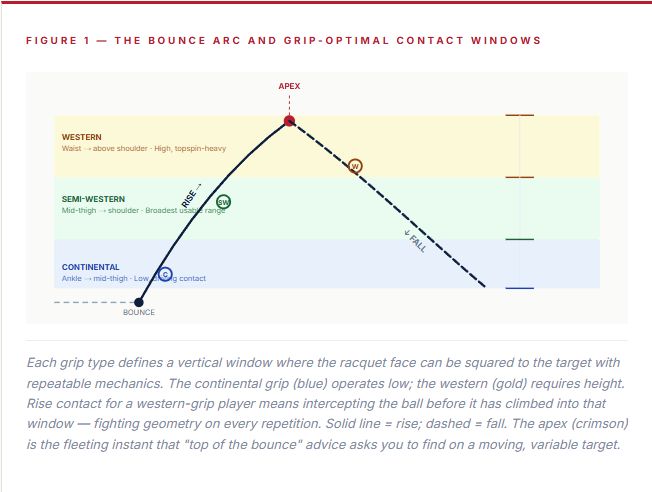
“Top of the bounce” sounds precise. It isn’t. The apex of a bounce is a single, fleeting instant whose height and location vary shot to shot with incoming pace, spin, and surface. Chasing a moving target that changes on every ball is not a swing thought — it’s a hope. Rise and fall are windows you can train to recognize and occupy on purpose; the apex seldom is.
The Grip Constraint
Grip sets the geometry of your strike zone before mechanics or tactics even enter the conversation.
A continental grip opens the racquet face relative to a semi-western or western grip at any given contact height, and that opening gets worse as contact height rises. Above shoulder height, a continental forehand drive has to fight the face angle with wrist and forearm compensation that most players — even good ones — cannot repeat under pressure (partly why the “chip” was a thing). That grip was built for low, driving, or slicing contact, not for handling a ball still climbing well above the shoulder.
A western grip has the opposite problem. It closes the face dramatically as contact height drops. Below knee height, a western forehand needs excessive additional wrist pronation and a much longer lever arm just to square the face — which is why western-grip players who get jammed on low balls often net or sail them. The grip simply isn’t built for that window. This alone should end the “everyone should take the ball on the rise” advice. A western-grip player taking the ball early and low, before it’s climbed into their strike zone, is fighting their own grip geometry on every single rep.
Anthropometrics and Stroke Mechanics
Height and limb length shift the strike zone vertically and shift preparation time along with it. A taller player with a longer lever has a naturally higher comfortable contact point and, generally, more time to let the ball travel before the swing has to start — the arc of the stroke covers more ground per degree of rotation. A shorter player with a more compact swing often needs to make contact earlier just to keep the racquet head from getting behind the body.
Stroke mechanics compound this. A big, loopy backswing with a long unit turn needs the ball to still be traveling with some pace and height to generate racquet lag and whip — which points toward the rise or even the top of the bounce. A short, compact, ATP-style unit turn with early racquet-head speed can wait, because the swing doesn’t need the ball’s residual pace to do its job — which points toward the fall. None of this is aesthetic preference. It’s timing math specific to that player’s limbs and swing shape.
Three professionals make this concrete:
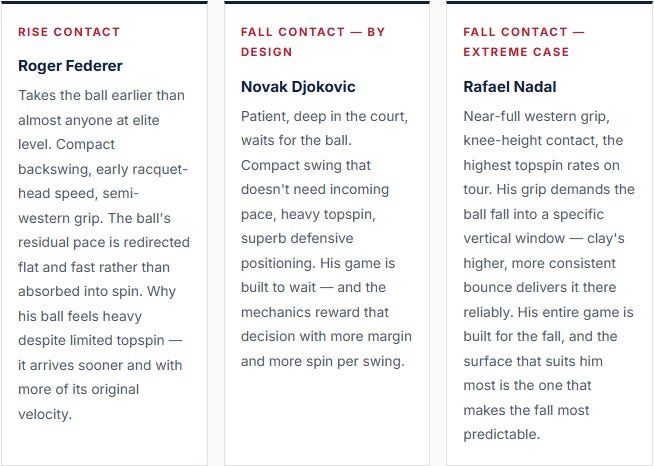
Three elite players, three different contact windows, all correct — for their grip, their mechanics, their height, their game ,and their surface of choice.
The Physics of Rise Versus Fall
This is where the racquet-speed and ball-direction differential actually explains the tactical intuition most players only have a feel for.
On the rise, the ball’s vertical velocity and the racquet’s vertical velocity — moving low to high on a topspin swing path — point the same direction. That shrinks the relative vertical velocity between strings and ball, which shrinks vertical shear across the stringbed. Less shear means less spin generated for a given racquet speed, but more of the ball’s own kinetic energy gets redirected forward instead of absorbed. Taking the ball early and letting the incoming pace do work for you is exactly why rise-based contact reads as flatter, faster, and more time-compressing for the opponent.
On the fall, the ball is descending while the racquet is still moving up along the same topspin path. Now the vertical velocities are opposed, relative velocity across the strings goes up, shear goes up, and spin production per unit of racquet speed goes up with it. Add in that the ball has already shed velocity to gravity and drag since its apex — it is physically slower on the way down — and the fall gives you two separate advantages simultaneously: more margin for error and easier topspin, at the cost of contact happening later, further back, and giving the opponent more recovery time.
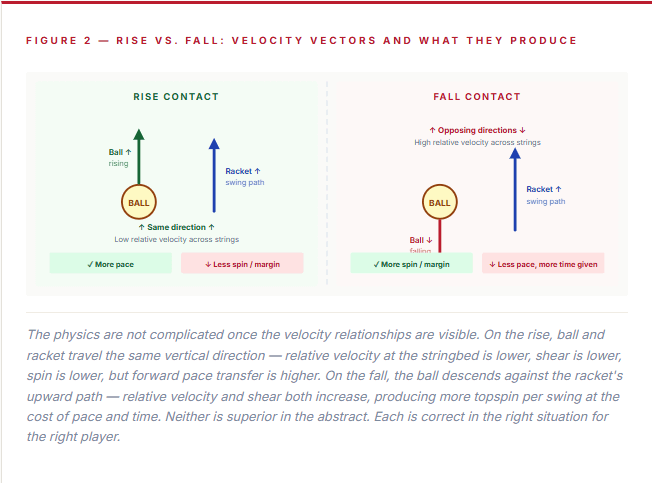
That tradeoff is the whole game. Fall-contact isn’t “safer” in some vague sense — it is mechanically safer (slower ball, more correction time) and mechanically better suited to heavy topspin, which is exactly why it’s the default contact window for neutral and defensive rallying, not a compromise players fall back to when they’re out of position.
Surface Changes the Default
The same player’s default contact point should shift by surface, because the surface changes how much the bounce itself can be trusted. On a true, fast, low-bouncing surface like indoor carpet or a firm hard court, the bounce is consistent enough that taking the ball earlier is low-risk — there’s little uncertainty being erased by waiting. On a slower or less consistent surface like clay, especially worn or chalky clay with skidding and bad bounces, waiting longer into the fall buys you the chance to see and correct for a misbehaving bounce before you commit the racquet. Clay rewards patience for exactly the same reason gravity rewards it: more time equals more information.
The Level Problem: What Works at the Top Ruins Players at the Bottom
Everything above applies to players who have the physical and technical prerequisites to actually execute the decision they’ve made. This is where “take the ball on the rise” — and “do what the pros do” as a general principle — becomes not just unhelpful but actively damaging.
A 13-14 (or higher) UTR aggressive baseliner playing off a hard-court or grass background can, in the right situation, step in and take most balls early. They have the hand-eye coordination to adjust to a ball still climbing, the depth perception to read where the ball will be in 300 milliseconds, and the footwork to position themselves aggressively without losing balance through contact. These are not small prerequisites. They represent years — usually a decade or more — of accumulated perceptual and motor development.
A developing player has none of that in place. And the sequence of failure is predictable: they stand too close to the baseline, misjudge the ball’s depth or pace, get caught as it rises faster than expected, and are forced to backpedal while swinging. Weight goes onto the heels. The kinetic chain collapses. The contact point ends up behind the body, at the wrong height, with the racquet face uncontrolled. The shot is a mechanical disaster — and the cause is not bad technique in isolation, it’s asking the player to execute a timing decision that requires equipment they don’t yet have.
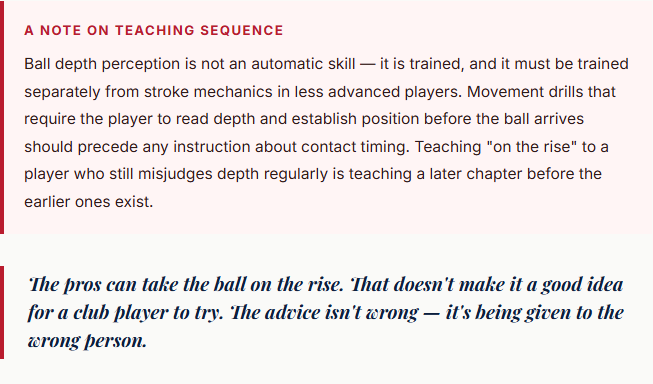
This extends far beyond tennis. The mistake of prescribing elite-level methods to developing athletes is universal in sport, and the analogy holds in any domain where elite practitioners have accumulated volume and intensity over decades:

This is precisely why progressive overload and long-term athletic development exist as principles — not suggestions. The body earns the right to handle higher demands through accumulated adaptation. Shortcutting that process by copying elite outputs without the elite foundation doesn’t accelerate development. It produces injury, frustration, and ingrained compensation patterns that take years to undo.
The Tactical Layer: Rise Versus Fall Is a Decision, Not a Style
Here’s the part that gets lost when contact point is treated as a fixed personal style rather than a live decision. Every player has a default — the contact window that matches their grip, mechanics, height, and preferred spin profile. But the choice to hit early or late in that window on any given ball should be governed by the state of the point, not habit.
If you’ve just moved your opponent off the court and the next ball leaves you a clearly favorable, low-risk opportunity to finish or take control, that’s the moment to step in and take the ball on the rise — you’re trading margin for time, and the trade is worth it because the reward is disproportionate. If your opponent is well-positioned, has time to recover, and there’s no clear advantage on offer, there’s no reason to take on the extra risk of early contact. Sit back into your fall-based window, take the pace off, generate the spin, and make them play another ball.
That’s the actual skill: not owning a single contact point, but owning a default built correctly for your body and swing, and having the judgment to know when the point in front of you is worth deviating from it.
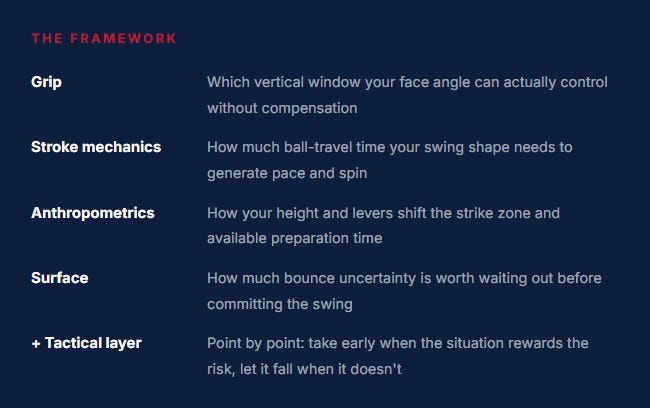
Anyone selling “top of the bounce” as the universal answer is selling an instant that doesn’t reliably exist, prescribed for a player they’ve never actually watched. The advice isn’t necessarily wrong. It’s just being given without context, to the wrong person, as though grip, height, mechanics, and surface don’t exist — and without a word about whether that player has the perceptual and motor prerequisites to act on it.