
Three Training Principles That Always Matter
Adaptation, progressive overload, specificity — the framework behind every training decision we make.

When an athlete steps onto the court, into the weight room, or onto the track, they’re introducing a challenge to their body—a stimulus that pushes against homeostasis, that state of comfortable balance. This isn’t incidental to training. It’s the whole point. And understanding how the body responds to that stress is foundational to building a plan that actually works.
Hans Selye, a Hungarian-Canadian biologist, first mapped this response systematically through his research on stress and adaptation. He called it the General Adaptation Syndrome, and while he documented it in controlled laboratory settings, the principle is universal. It applies to insects under noxious stimuli. It applies to skin under sun exposure. And it applies to tennis players hitting serves, running the baseline, or lifting weights.
Here’s how it works:
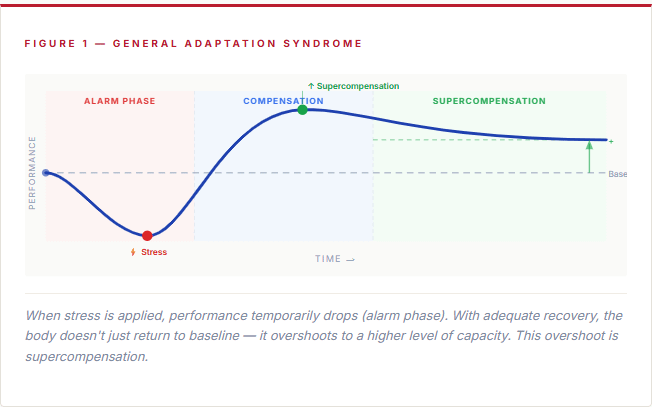
When stress is introduced, the organism first enters an alarm phase. In this moment, performance actually dips. The body is disrupted, weakened temporarily. If you’ve ever gotten a sunburn, you know this phase—the skin is red, inflamed, compromised. If you’ve hit heavy weights, your muscles are fatigued. The system is in distress.
But here’s where adaptation happens. Given adequate recovery, the body doesn’t simply return to where it started. It overshoots. This overshoot is called supercompensation—the body doesn’t just compensate for the stress, it compensates beyond it. The sunburned skin doesn’t just return to its original tone; it tans slightly darker, giving the body a slightly higher tolerance for UV exposure next time. The muscles don’t just recover to their prior strength; they build back slightly stronger. The connective tissues in your shoulder, your arm, your wrist—they adapt to the specific demands you’ve placed on them.
This is why training works at all. And this is why the first principle is non-negotiable.
Principle One: Adaptation
Every training stimulus—whether it’s the connective tissue responding to a hundred forehands hit, the cardiovascular system adjusting to court movement patterns, or the muscles tightening from loaded squats—triggers this adaptation cycle. The body is always trying to meet the demands you’re asking it to meet.
But adaptation only happens if three conditions are met: the stress must be real, recovery must be adequate, and the stress must be repeated. One sunburn doesn’t give you a tan. One heavy lifting session doesn’t build muscle. One practice doesn’t ingrain a stroke. The adaptation cycle needs to cycle.
This is where the second principle comes in, because if you’re not careful, you can break the system.
Principle Two: Progressive Overload
Adaptation is powerful, but it’s also efficient. Your body adapts to exactly what you’re asking it to adapt to. If you hit a hundred forehands today and a hundred forehands tomorrow and a hundred forehands next week, your body adapts to that hundred. It doesn’t keep improving forever. The stimulus becomes the new normal, and the supercompensation stops.
This is why progressive overload matters. After adaptation occurs, the next stimulus must be slightly greater than the last. Not drastically greater—incremental progression is what builds sustainable adaptation. It’s what separates training from habit.
In the weight room, this is straightforward: Monday you bench press a thousand pounds of total volume. Wednesday, you do a thousand and ten, or a thousand and fifty. In the sun, it’s simple math: twenty minutes of exposure becomes twenty-two minutes, or the same twenty minutes in slightly higher UV. On the court, you run nine laps instead of eight, or you hit forehands for thirty-five minutes instead of thirty.
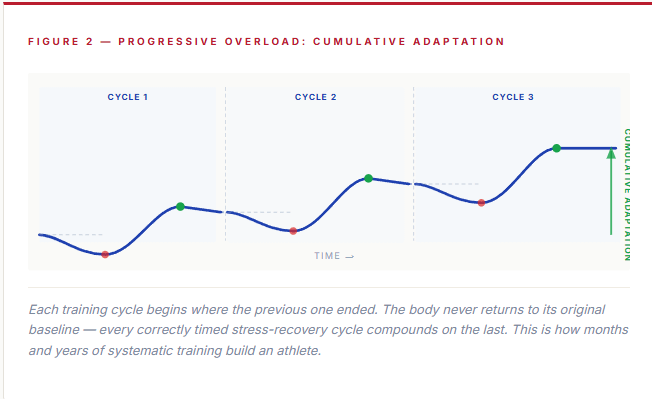
The timeline matters less than the direction. Progression can happen from one session to the next. It can happen weekly, where this week’s volume exceeds last week’s. It can happen across a training block—this month we do more than last month. The rate of progression depends on the athlete’s level: novices adapt quickly to new stimuli, so they can progress faster. Advanced athletes have already adapted to most standard stresses, so progression becomes more nuanced and methodical. But in either case, the principle remains: more than last time.
This progressive exposure is what builds resilience, whether that’s sunburn tolerance, muscular strength, or the durability of connective tissues in the shoulder and arm.
But here’s the catch: it has to be the right kind of progressive overload.
Principle Three: Specificity
This is where many training plans fall short, and it’s the broadest of the three principles because specificity touches everything.
Specificity means the stress you apply must match the demands of the environment the athlete will actually face. It applies to energy systems: are you building aerobic capacity or anaerobic power? It applies to movement patterns: are you training unidirectional running or the multidirectional explosiveness of court movement? It applies to technique and stroke production. It applies to duration, intensity, it applies to flexion of joint angles, slide mechanics, surfaces, recovery profiles and a lot more.
If you’re a tennis player, you can’t just run distance on a track and expect that to transfer fully to court performance. You can’t just lift heavy weights and expect the connective tissues to adapt specifically to serving motion. The body adapts to what you ask it to adapt to. And if what you’re asking it to adapt to doesn’t match what the game demands, you’re leaving performance on the table.
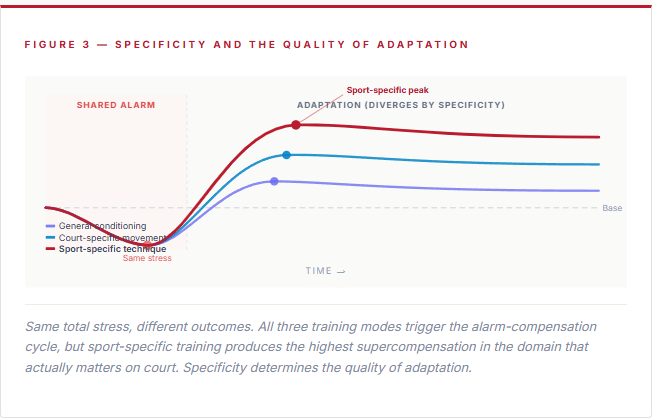
This doesn’t mean every session has to be sport-specific. General preparation/adaptation has its critical place, and it is actually a great starting point. However, the training plan as a whole must be designed so that the athlete’s adaptation is gradually tuned toward the competitive environment they’ll face. The timing is a whole different matter, deserving of its own thread.
Putting It Together
These three principles—adaptation, progressive overload, and specificity—are not optional. They’re foundational. A training plan that ignores any of them is leaving performance on the table. It might still produce results, especially with novice athletes who adapt to almost anything new. But it won’t be optimal. It won’t be efficient.
When you design a plan for a tennis player, every decision flows from these three principles. How much is the athlete stressed? Is there adequate recovery? Is the next session slightly more demanding than the last? And critically: does this stress teach the body what it needs to know to compete?
Answer those questions well, and you’ve got the framework for a plan that works.
Nandor Veres Jr., MS Exercise Physiology, is a performance coach and strength and conditioning specialist. NSCA-CSCS · TSAC-F · PTR Certified. Davis Cup Coach — Hungary.
Fun to read, thank you! 👌
So much great info packed in here! 💪