
Training vs. Exercise: The Five Variables That Make the Difference
Frequency, intensity, timing, tempo, and volume are not concepts — they are the tools of structured programming.

In the previous piece, we established the three principles that govern all training adaptation: the body responds to stress through supercompensation, that stress must be progressively increased, and the stress must match the demands of the competitive environment. Those principles explain why training works. They don’t explain what you actually do.
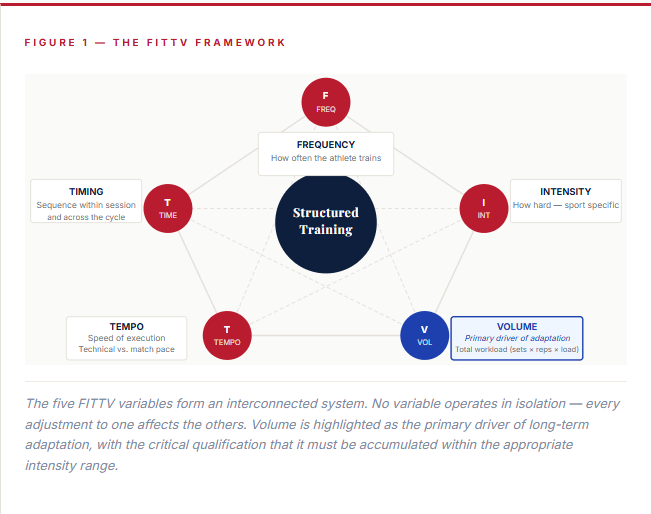
What sits inside that framework — what you manipulate day to day, week to week, year to year — are variables. Specifically, five of them. We call this the FITTV framework: Frequency, Intensity, Timing, Tempo, and Volume.
Understanding these variables is what separates training from exercise. And that distinction matters more than most coaches, parents, and athletes realize.
Training vs. Exercise
Exercise is movement. It’s beneficial, it produces adaptation, and it’s better than nothing. But exercise is unstructured. You go for a run. You hit balls for an hour. You lift whatever weight feels manageable. The body responds — novice athletes especially will improve doing almost anything that challenges them — but the response is limited, and it plateaus.
Training is deliberate. It is the systematic manipulation of specific variables within a framework built on sound principles. The stress is intentional. The recovery is planned. The progression is tracked.
When we systematically control these variables, we’re training. When we don’t, we’re exercising.
The distinction becomes critical as an athlete advances. Novices improve on almost any stimulus because the gap between their current capacity and their potential is enormous. But as adaptation catches up, as the athlete becomes more trained, random stress produces diminishing returns. The stimulus must be precise. The variables must be controlled.
This is when the coach becomes essential — and when the FITTV framework becomes indispensable.
Variable One: Frequency
Frequency is how often the athlete trains a given quality or movement pattern within a given time period. A novice runner might train twice per week; an elite marathoner may run six days. A competitive junior tennis player might hit on court four days per week, while a professional trains twice daily.
The principle governing frequency is straightforward: more frequent exposure to a specific stress produces faster adaptation, up to the point where recovery can no longer keep pace. Frequency is always a function of the athlete’s ability to recover. Too little frequency, and supercompensation cycles are lost. Too much, and the alarm phase never resolves — fatigue accumulates without the compensation phase that produces growth.
Scaling frequency correctly to an athlete’s training age, recovery capacity, and life demands is one of the fundamental decisions in program design. For developing juniors, it is one of the most commonly miscalibrated (more on this in the future).
Variable Two: Intensity
Intensity is where context becomes everything, because it means different things in different sports — and this is precisely why specificity cannot be separated from how we define intensity.
In the weight room, intensity is measurable: it is expressed as a percentage of an athlete’s one-repetition maximum. Eighty percent of 1RM for a squat is a specific, calculable load. Six repetitions at that percentage produces a specific, predictable stimulus.
On the tennis court, intensity cannot be expressed as a percentage of maximum — but it can be expressed as a relationship to the demands of competition. A drill run at 70% effort is low intensity even if the athlete is sweating. Point play at match pace under tactical pressure is high intensity regardless of duration. And this matters in ways that are frequently overlooked: training for one-set matches when your tournament runs best-of-three — or best-of-five at the international level — is a failure of intensity design. The athlete is not prepared for what competition actually demands.
Variable Three: Timing
Timing refers to the deliberate sequencing of training elements — within a session, within a week, and across a training cycle.
Within a session: strength and power work is placed before conditioning because the neuromuscular system is freshest early. Technical tennis work belongs early in a session for the same reason (except under special circumstances) — fatigue degrades the quality of movement and the quality of the learning signal. You don’t refine a serve after three hours on court.
Within a week: timing determines which qualities are trained on which days, and how recovery is distributed between demanding sessions. Within a cycle: timing refers to when training emphases shift — from general physical preparation to sport-specific work, from development to competition preparation. This is where periodization begins, and where we’ll pick up in the next piece.
Variable Four: Tempo
Tempo is the speed at which training is executed, and it is one of the most underappreciated variables in tennis development.
In the weight room, tempo is explicit: a squat performed with a controlled three-second descent and an explosive concentric is a fundamentally different stimulus than the same weight moved quickly throughout. Slow tempo under load builds structural and connective tissue adaptations. Explosive tempo trains the neural firing patterns that athletic performance demands (rate of force development, which might set a collegiate power athlete apart from an Olympic one).
On court, tempo is the difference between slow technical drilling and match-pace point play. A beginner working on forehand mechanics at half-speed is building motor patterns. A competitive player hitting full-pace groundstrokes off live feed under time pressure is training match-tempo execution.
The critical point: training predominantly at low tempo — comfortable, technically safe, unhurried — does not prepare the athlete for the pace of high-level competition (explains why excessive drilling rarely translated to competitive success). Gradually increasing training tempo is a form of progressive overload applied specifically to movement speed, precision and decision-making under pressure.
Variable Five: Volume
Volume is total workload. In the weight room, it is calculated precisely: sets multiplied by repetitions multiplied by load lifted. On court or on the track, it is time accumulated, distance covered, or total repetitions performed. It is the most important of the five variables — with one essential qualification.
Volume drives adaptation within the appropriate intensity range. Volume at the wrong intensity produces the wrong adaptations, or no meaningful adaptation at all.
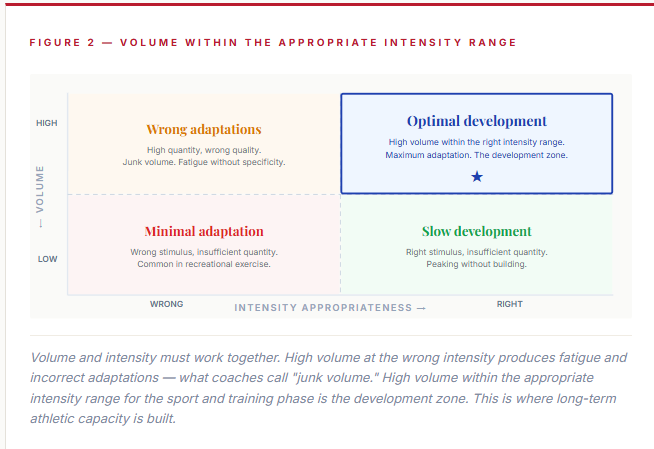
This relationship explains one of the most consequential (and often misunderstood) concept in athletic development: the cost of peaking. To optimize performance for a specific competition — to reduce accumulated fatigue and allow the athlete’s full capacity to express itself — volume must be reduced. The athlete feels sharp, fast, ready. But the price is that long-term adaptation slows. Every week spent at reduced volume is a week not spent accumulating the stimulus that builds the athlete.
This is why the structure of a competitive calendar matters enormously. And it is why indiscriminate peaking — treating every tournament as a peak event — is one of the most damaging practices in youth athletic development. But that discussion requires understanding how volume and intensity are periodized across training cycles. Which is exactly where we’re going next.
Putting It Together
The FITTV variables are not independent levers. Every decision about one affects the others. Increase frequency and you may need to reduce volume per session. Increase intensity and recovery windows must extend. Shift tempo toward match pace and technical precision becomes harder to maintain. Managing these interactions deliberately — within the framework of the three principles established in No. 01 — is what program design actually means.
A program is not a workout plan. It is a structured manipulation of variables over time, built to produce a specific athletic outcome at a specific point in a competitive career. When a coach builds a program, they are answering five questions simultaneously: How often? How hard? In what order? At what speed? How much? And they are answering those questions not just for today’s session, but for the week, the month, and the year.
The system that governs how those answers change across training cycles — how volume and intensity are periodized, how competition is integrated into development, and how the athlete is built season to season and year to year — is what we’ll examine in the next piece.
From the Court is a series on the science and methodology behind elite tennis development. · No. 01: Three Training Principles That Always Matter · No. 02: Training vs. Exercise: The Five Variables That Make the Difference · No. 03: Why “Tennis Wrist” Isn’t About How Much You Play — coming July 14 · No. 04: Why We Design Programs — coming July 21
Nandor Veres Jr., MS Exercise Physiology, is a performance coach and strength and conditioning specialist. NSCA-CSCS · TSAC-F · PTR Certified. Davis Cup Coach — Hungary.