

The Lazy Diagnosis
Ask most parents — or most coaches, honestly — why their junior developed wrist pain, and you’ll get the same answer every time: too much volume. Too many reps, too many tournaments, too many hours on court.
It’s a comfortable explanation because it requires no technical accountability. But it doesn’t hold up. Every serious junior hits enormous volume. If repetition alone caused extensor tenosynovitis, every high-performance player would have it, all the time. They don’t. Some players go a decade at elite volume without a flare-up. Others develop it in a single intensive block.
The variable that actually predicts who gets hurt isn’t how much they swing. It’s how they’re using the wrist to generate speed.
This piece is about that variable.
What the Extensors Are Actually For
The wrist extensors — and specifically, in tennis, the tendons most often involved — are not power-generating muscles in a tennis stroke. The extensor carpi ulnaris (ECU), on the ulnar or backhand side, and the abductor pollicis longus and extensor pollicis brevis (APL/EPB) on the thumb side are structures built for a very different job: eccentric control and isometric stabilization.
Think of them as the muscles that manage the wrist’s position while other structures generate racket head speed — the shoulder rotating internally, the forearm pronating, the trunk uncoiling. The extensors are supposed to be passengers for most of the stroke, occasionally called on to decelerate or hold, rarely called on to actively produce force.
These tendons run through narrow anatomical tunnels — retinacular compartments — that function like a rope running over a pulley. Under normal use, the rope glides freely. Under repeated sharp-angle loading or sustained tension without adequate fluid exchange, the rope frays against the pulley wall. That’s tenosynovitis, mechanically speaking: irritation of the synovial sheath from friction or restricted gliding, concentrated at the exact point where the tendon changes direction around bone.
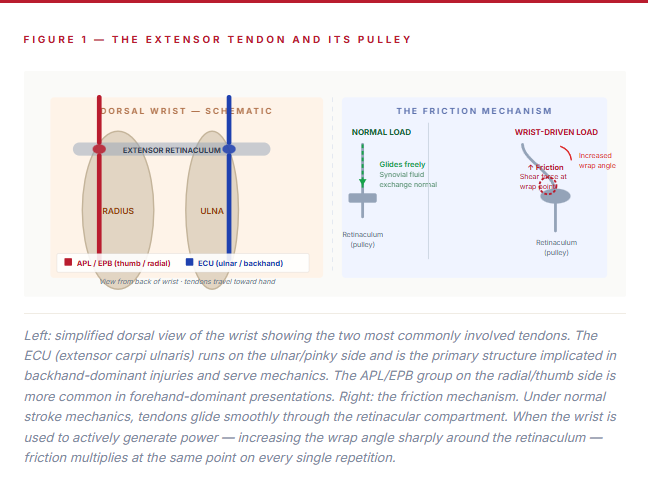
The pathology isn’t caused by using the tendon. It’s caused by using it in a role it wasn’t designed to fill — and doing so at the angular velocities and repetition rates of serious tennis training.
The Real Fault: What Happens After the Cock
Every player cocks the wrist into extension (to varying extent) on the takeback. That part is normal and even necessary; it’s part of loading the kinetic chain. The fault isn’t the cocking itself. The fault is what the player does to resolve it.
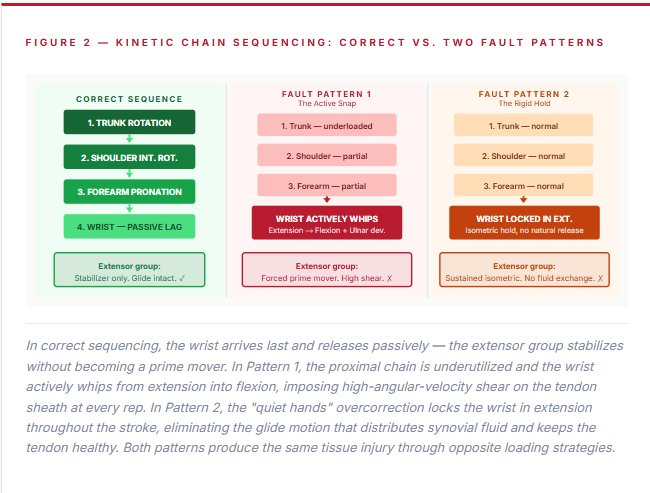
There are two failure patterns, and they produce the same injury through opposite mechanisms.
Pattern 1: The Active Snap
The player uses the cocked wrist as a slingshot. Instead of letting forearm pronation and shoulder rotation drive racket head speed — with wrist flexion arriving as a passive, lagging consequence — the player actively whips the wrist from extension into flexion, often combined with ulnar deviation, to manufacture speed themselves.
This is a proximal-to-distal sequencing failure. Power that should originate from the trunk, shoulder, and upper arm is instead being generated by small muscles never designed to be prime movers. The extensor tendon has to reverse from a lengthened, loaded position into rapid eccentric deceleration, through a short range of motion, right at the point it wraps around the retinaculum. High angular velocity, short arc, and a tight wrap angle together create the exact loading scenario that shears a tendon sheath.
Pattern 2: The Rigid Hold
The opposite compensation — often the direct result of over-corrected “quiet hands” coaching — has the player actively holding the wrist rigid in its cocked, extended position all the way through contact, using the extensors isometrically to fix the joint rather than allowing it to move naturally.
This looks safer. It isn’t. Tendon sheaths depend on motion for synovial fluid exchange and nutrition. Sustained isometric loading without glide starves the tendon of that exchange and creates a different flavor of the same irritation — chronic and low-grade rather than acute, but mechanically just as real.
The fault isn’t how much the wrist moves. It’s whether the wrist is generating the speed or transmitting it.
Why Grip Geometry Compounds Both Patterns
The angle at which a tendon wraps around its retinacular pulley isn’t fixed. It changes with wrist position, which changes with grip. A player using an extreme grip — a full western forehand, or a backhand grip carried awkwardly into a pronation-heavy serve pattern — alters the resting angle of the wrist relative to the forearm. Even a small increase in ulnar deviation at contact meaningfully increases the wrap angle for the ECU tendon specifically, increasing friction on every single repetition regardless of total volume.
This is why two players with identical hitting volume can have completely different risk profiles. It was never about the number of swings. It was about the angle and velocity the tendon experiences on each one. If Alcaraz’s reported ECU involvement is accurate, this is precisely the structure that a heavy topspin forehand with high angular wrist velocity would load most aggressively — the same shot that defines his style.
The Diagnostic Question for Coaches
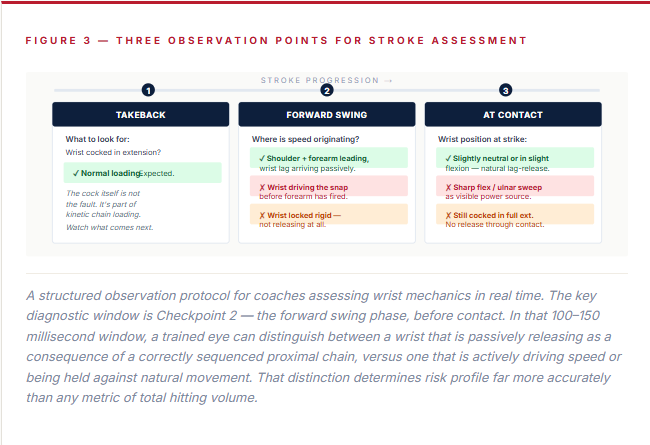
If you want to actually assess risk in a player’s stroke, don’t count reps. Watch the last 100 milliseconds before contact and ask one question: where is the racket head acceleration actually coming from?
If you see the wrist collapsing from extension into flexion — or sweeping into ulnar deviation — as the source of speed, rather than as a passive consequence of forearm pronation and trunk rotation that’s already underway, you’re looking at the fault. It doesn’t matter whether the player’s coach calls it a “wrist snap,” a “pop,” or a “release.” If the wrist is generating speed rather than transmitting it, the extensor group is being asked to do a job it isn’t built for, and the sheath is absorbing the cost.
The Fix Isn’t Fewer Reps — It’s Better Sequencing
The correction here isn’t load management in the generic sense. It’s re-establishing the correct kinetic chain sequence. Racket head speed should originate from shoulder internal rotation, forearm pronation, and trunk rotation, arriving at the wrist last — with wrist flexion as a natural, largely passive lag-release rather than an actively generated whip. Get that sequencing right and the extensor group returns to the role it was designed for: a stabilizer and a decelerator, not a power source. The friction that produces tenosynovitis simply stops accumulating, regardless of how many balls the player hits.
This is not a small coaching correction. For players who have been generating speed from their wrist for years, the re-sequencing requires temporarily accepting that their shots will lose pace while the new pattern is learned and reinforced to the point of automaticity. That requires a coach who understands why the correction is necessary, and an athlete who trusts the process during the transition. Both are rarer than they should be.
The Management vs. Prevention Distinction
Load management — reducing volume, resting, using anti-inflammatory protocols — addresses the symptom, not the mechanism. It allows the irritated tendon to calm down, but it does not change what the tendon will be asked to do when the player returns to full training. In the absence of a technical correction, the injury recurs. This is the pattern seen in players who go through repeated “wrist issues” across a career: the mechanics are never addressed, only the load.
True prevention requires identifying which failure pattern is present — active snap or rigid hold — and addressing the underlying sequencing error at the technical level. Load management is appropriate as concurrent support, particularly during acute phases. It is not, on its own, a solution.
Volume is not the enemy. Poor mechanics at volume are. The difference between those two statements is the difference between pulling a junior off the court every time their wrist flares — and never building the mechanical quality that would have made the flare-up unnecessary in the first place.
From the Court is a series on the science and methodology behind elite tennis development. · No. 01: Three Training Principles That Always Matter · No. 02: Training vs. Exercise: The Five Variables That Make the Difference · No. 03: Why “Tennis Wrist” Isn’t About How Much You Play · No. 04: Why We Design Programs — coming July 21 · No. 05: There Is No “Optimal” Contact Point — There’s Yours — coming July 28 · No. 06: A Letter to Tennis Parents — coming soon