
Why We Design Programs
Periodization, the fitness-fatigue model, and the long view of athletic development — from the weekly plan to the annual cycle to a career.

The first piece in this series established the three principles that govern all adaptation. The second gave names to the variables we manipulate — frequency, intensity, timing, tempo, volume. Now the question is: what do you do with all of that?
The answer is a program. Not a workout. Not a session. A program — a deliberate, structured manipulation of training variables over time, built around the athlete’s competitive calendar, guided by the principles of adaptation, and designed to produce a specific outcome at a specific moment.
This is periodization. And understanding it changes how you see everything: why certain athletes plateau, why others peak at the right moment, why peaking for the wrong event costs more than it gains, and why the best development decisions are almost always the ones that look counterintuitive in the short term.
Programming vs. Periodization
These two terms are used interchangeably and they shouldn’t be. They describe different levels of planning.
Programming is the session-to-session structure: what you do today, how it connects to what you did yesterday, and how it sets up what comes tomorrow. It is the immediate execution layer — sets, reps, drill sequencing, recovery intervals.
Periodization is the architecture that programming lives inside. It is the planned manipulation of training variables across weeks, months, and years to maximize adaptation at the right time. Dr. Michael Zourdos, a distinguished researcher in resistance training periodization, defines it precisely as “planned manipulation of training variables to maximize adaptations.” The key word is planned. Without a plan, you have exercise. With a plan, you have development.
Research is unambiguous on this point. Periodized training consistently outperforms non-periodized training across populations — trained athletes, untrained individuals, men, women, all age groups. More recent meta-analyses confirm not just that periodization works, but that undulating models — where training emphases change frequently rather than remaining static for months — produce superior outcomes compared to traditional linear approaches. The body responds better to varied, planned stress than to monotonous, unvaried stress at the same intensity.
But to understand why periodization is necessary — not just beneficial — you need to understand what training actually does to the body in the short term. Which requires understanding the fitness-fatigue model.
The Fitness-Fatigue Model
When you train, two things happen simultaneously. First, a fitness effect: the biological adaptations that, over time, produce a stronger, faster, more capable athlete. Second, a fatigue effect: the accumulation of systemic stress — muscular damage, neural fatigue, hormonal disruption — that temporarily suppresses the ability to perform.
Both effects are triggered by the same training stimulus. They are inseparable. You cannot produce one without the other.
What makes this consequential is that fitness and fatigue decay at different rates. Fatigue accumulates quickly and — critically — also dissipates quickly. Fitness accumulates more slowly and also decays more slowly. The athlete’s actual, expressed performance at any given moment is the result of these two curves interacting.
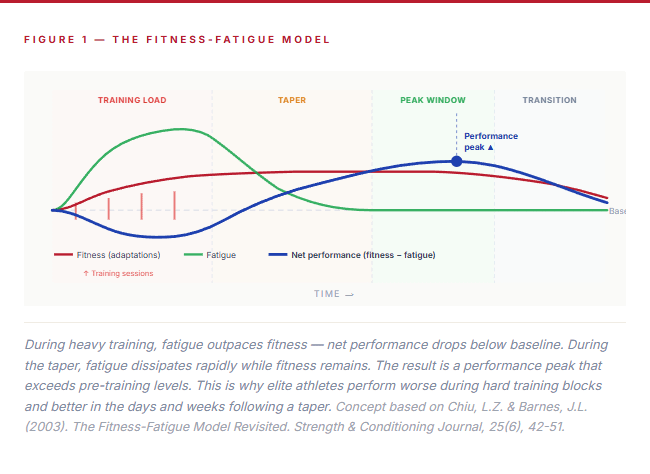
The implication of this model is direct and important: an athlete’s best performance does not occur during their hardest training. It occurs after it — once the taper has cleared the fatigue while the fitness gained from that training remains elevated. The performance peak is not a product of resting. It is a product of having trained hard enough to build genuine fitness, then recovering long enough for fatigue to dissipate.
This is what the taper does. It does not build fitness. It reveals fitness that already exists, by removing the fatigue that was obscuring it.
Peaking doesn’t build the athlete. It uncovers what the training built — by removing the fatigue that was hiding it.
And this is precisely why indiscriminate peaking is so costly. Every taper, every competition week, every voluntary reduction of training volume to sharpen for an event — these remove the fatigue, yes. But they also interrupt the accumulation of training stress that builds fitness. You cannot peak and develop simultaneously. Every athlete and every coach is always making that trade, whether they recognize it or not.
The Three Cycles of Periodization
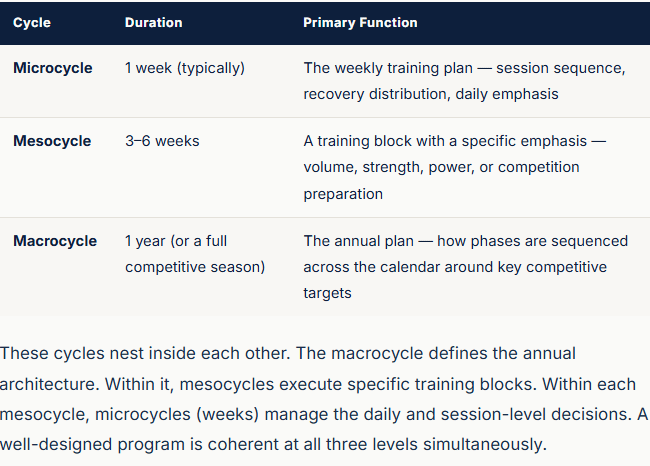
Periodization operates across three time scales simultaneously. Understanding all three — and how they nest inside each other — is what separates program design from guesswork.
The Annual Plan: Four Phases
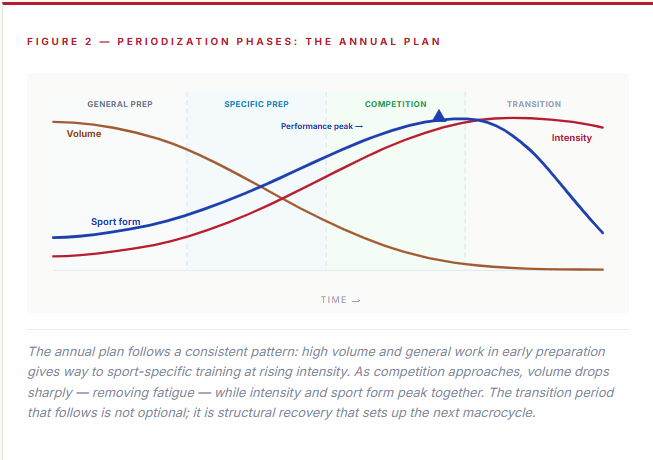
At the macrocycle level, the annual training plan follows a consistent architecture across almost all sports. The specifics vary — the duration of each phase, the methods used within it — but the underlying pattern is universal. Volume starts high. Intensity rises as volume drops. The athlete peaks. Then the athlete transitions.
General Preparation
This is the foundation phase. Volume is high, intensity is moderate, and the work is broad — building the general physical capacities that sport-specific training will later refine. Aerobic base, structural strength, movement quality. In tennis, this is when running volume is highest, lifting emphasizes hypertrophy and foundational strength, and on-court time focuses on technical development and drill-based repetition rather than competitive point play. For the developing player, this is the most productive phase where majority of time should be spent to maximize long term development.
Specific Preparation
Volume begins to decline as intensity rises. The nature of the training shifts toward the specific demands of competition — more point play, more match-like conditions, more sport-specific conditioning. Strength work transitions from hypertrophy emphasis toward power and speed. The athlete is being tuned toward competition without yet sacrificing the volume that has been building their capacity.
Competition Phase
Volume drops significantly. Intensity and sport form peak. This is the taper — fatigue is cleared, and the fitness built over months of accumulation is fully expressed. Technical coaching is reduced during this phase; the athlete competes with what they have. This is not the time to fix a backhand or introduce new patterns. The competitive phase is where the development work is tested, not where it happens.
Transition Period
After competition, everything is reduced for one to two weeks — sometimes longer depending on the depth of the training block and the demands of the season. This is not laziness. It is structural. The transition period allows physical and psychological recovery, prevents accumulated fatigue from becoming chronic fatigue or injury, and prepares the system for the next macrocycle to begin. Skipping the transition in pursuit of year-round training is a common and costly mistake.
A Practical Example: Structuring Running for the Tennis Player
Every serious tennis player — aspiring collegiate, aspiring professional — should have running as a foundational training modality. This is not a popular position in an era of highly specific court-only training programs, but it is well-supported and, in my experience, non-negotiable at the highest levels of the game.
The physiological argument is straightforward. Consistent running produces adaptations that are directly transferable to competitive tennis: increased capillarization (more efficient oxygen delivery to working muscles), greater mitochondrial density (enhanced aerobic power and endurance within the muscle cell), improved recovery between points, between sets and between sessions, greater load tolerance, better heat tolerance, and meaningful adaptation to altitude changes — all of which matter for athletes competing internationally across different environments and elevations.
These adaptations are catalogued extensively in the exercise physiology literature. The NSCA’s Strength and Conditioning textbook presents comprehensive tables of cardiovascular and metabolic adaptations to endurance training — and virtually every one of them has a direct application to the traveling competitive tennis player.
Within the general preparation phase, a well-designed running microcycle for a competitive junior or collegiate player might look like this:
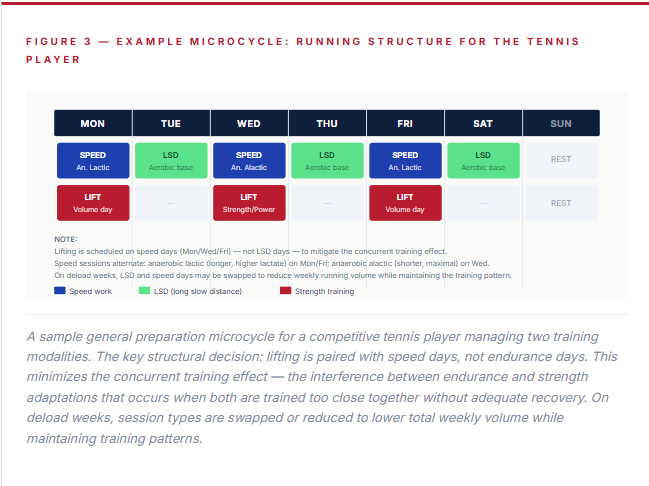
The complexity of managing just two training modalities — running and strength (though simplified and non-granular)— across a single week is already significant. Add on-court technical work, tactical development, and match play, and the number of interactions between variables multiplies rapidly. This is why program design is a profession and not a formula. The principles and variables give you the language. The design is applied judgment, responsive to the individual athlete.
The Development Imperative: Why We Don’t Peak for Weekend Tournaments
Everything described above — the fitness-fatigue model, the annual plan, the careful management of volume and intensity across phases — leads to one of the most important and most contested positions in junior tennis development. We do not peak for local tournaments. We don’t reduce volume the week before. We don’t take Friday and Monday off. We don’t treat a regional 12-and-under event with the same preparation as an international competition (ie. ITF).
This is not a coaching preference. It is a logical consequence of the model.
Development, in the junior stage, is driven by the accumulation of training volume within the appropriate intensity range. That is the mechanism. Reducing volume to sharpen for a competition interrupts the mechanism. The athlete may perform slightly better at that tournament — fatigue is lower, they feel quicker and sharper — but the cost is paid in adaptation. The weeks spent peaking are weeks not spent developing. For a junior athlete whose primary goal is long-term development rather than results, this is a deeply unfavorable trade.
The numbers make this concrete. In a typical five-day training week, taking Friday and Monday off around a weekend tournament removes two full training days. Depending on session structure, that can represent 35 to 40 percent of the week’s training volume — gone, repeatedly, across a season. Over a year of regular tournament play with conventional preparation, the cumulative loss in training volume is not trivial. It is enormous.
ITF Junior Tournament Structure: No international tournaments are permitted under age 13. From ages 13–14, a maximum of five international tournaments total are allowed. From age 14 onward, an athlete’s ITF junior ranking is determined by their best five or six results. In practice, this means a serious junior player has approximately two to four genuinely consequential tournament cycles per year — the events that actually determine their international standing. Everything else is development, regardless of whether it is treated that way.
There is an additional specificity problem embedded in the US junior tournament calendar that compounds this issue. The vast majority of American junior tournaments, from local to regional level, are played as two out of three sets with a ten-point tiebreak in place of a third set. International junior competition — and virtually all professional-level play — uses best-of-three full sets, minimum. That is at least fifty percent more tennis than most American juniors routinely train or compete to finish.
An athlete who trains predominantly for one-set and two-set matches — who peaks for those formats, whose conditioning is calibrated to those durations — is not prepared for three-set international competition, physically or mentally. This is a specificity failure embedded in the structure of the development environment itself, and it requires deliberate correction through training design.
The practical answer: treat most domestic tournaments as training events. Maintain normal training volume the week before and the week after. Use the match as a high-intensity, high-specificity training stimulus — exactly what it is. Reserve genuine peaking protocols for the handful of events per year that warrant them: international travel, significant ranking implications, events with real competitive stakes commensurate with the development cost of the taper.
Most tournaments in the development stage are not competitions. They are the most specific training sessions of the week — and they should be treated accordingly.
Long-Term Athletic Development: The Frame That Contains All of This
The Long-Term Athletic Development (LTAD) framework provides the larger context in which everything above operates. At its core, LTAD asserts that athletic development is a long-term process — measured in years and decades, not seasons — and that the training emphasis at any given stage of development should be determined by the athlete’s developmental age, not their competitive results or their parents’ ambitions.
In tennis, the development stage extends roughly until age 16 to 18, depending on the individual — their biological age, their training age (how long they have been in structured training), and their physical and competitive maturity. During this period, the emphasis should be overwhelmingly on building the physical, technical, and tactical foundations that will allow the athlete to compete at the highest level later. Results during this stage are largely irrelevant to long-term outcomes. Early specialization, early competitive pressure, and premature peaking are consistently associated with burnout, injury, and failure to reach potential — and consistently uncorrelated with elite adult performance.
The coach’s job, during the development stage, is not to win tournaments. It is to build athletes. The program is the tool. Periodization is the method. Volume is the lever. And patience — structured, principled, unhurried patience — is the non-negotiable requirement.
What Comes Next
The three pieces in this series have built a complete framework: the principles that govern adaptation, the variables we manipulate, and the system — periodization — through which those variables are organized over time into a program that develops athletes for the long term.
From the Court is a series on the science and methodology behind elite tennis development. · No. 01: Three Training Principles That Always Matter · No. 02: Training vs. Exercise: The Five Variables That Make the Difference · No. 03: Why “Tennis Wrist” Isn’t About How Much You Play · No. 04: Why We Design Programs ·
Nandor Veres Jr., MS Exercise Physiology, is a performance coach and strength and conditioning specialist. NSCA-CSCS · TSAC-F · PTR Certified. Davis Cup Coach — Hungary.